
Beyond Keywords: Why AI Data Enrichment Is the Missing Link for AI‑Powered Commerce

Search is often treated as a relevance problem. In reality, it’s a data problem.
Across B2B and B2C commerce, teams invest heavily in tuning ranking models, deploying semantic search, and experimenting with generative AI. Yet results still fall short. Shoppers see too many “no results” searches, weak recommendations, and frustrating discovery experiences. The root cause is surprisingly consistent: product data that doesn’t reflect how people actually search.
At Lucidworks, we see this pattern across some of the world’s largest and most sophisticated retailers. Even well‑maintained catalogs are functionally broken for modern AI because they lack depth, context, and language that matches real user intent. That’s why we built Lucidworks Data Enrichment.
The Hidden Cost of Incomplete Product Data
Most commerce catalogs suffer from at least one of these issues:
- Product titles are short, inconsistent, or overly technical
- Descriptions lack shopper language or key attributes
- Keywords and synonyms don’t match real queries
- Categories are vague, overlapping, or ambiguous
When this happens, search systems, no matter how advanced, can only retrieve what exists in the data. The result is low recall, abandoned sessions, poor personalization, and stalled AI initiatives. In fact, up to 30% of searches fail due to incomplete product data, which directly impacts revenue and the customer experience.
This is where traditional approaches break down. Manual tagging doesn’t scale. Writing better copy takes time, and it still misses how customers actually search. Text‑only AI enrichment ignores one of the richest sources of information in commerce: images.
A Modern Fix: Multimodal Data Enrichment
Lucidworks Data Enrichment uses multimodal generative AI to analyze product images alongside existing text and metadata. By understanding visual and semantic context together, the system automatically generates:
- Disambiguated subcategories
- High‑quality keywords and synonyms
- Richer, search‑ready descriptions
This enrichment is delivered as an offline, automated, and scalable AI Booster, with outputs ready to be indexed directly into Lucidworks’ platform. No manual tagging. No replatforming. No disruption to existing workflows.
The result is a dramatically richer product data that search and AI systems can finally work with.
Illustrative Example
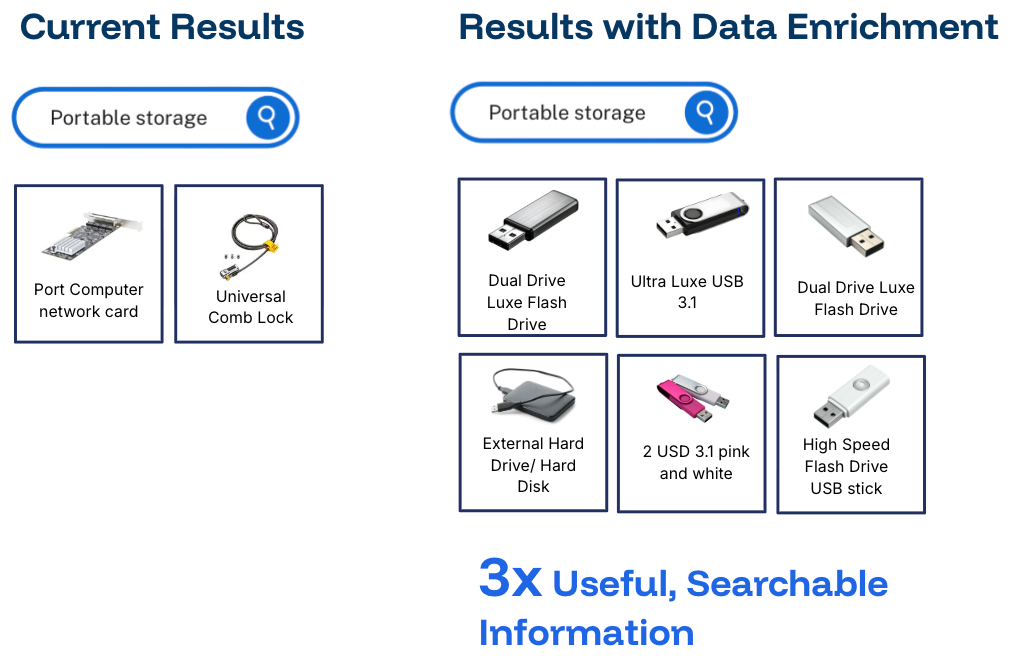
AI-enriched vs non-enriched catalog data
| Dimension | Non-enriched catalog data | AI-enriched catalog data with Lucidworks |
|---|---|---|
| Product understanding | Limited to short titles and sparse descriptions. | Rich understanding of product intent using images and context. |
| Search recall | Low recall; many relevant products never appear. | High recall; more products correctly matched to user queries. |
| “No results” searches | Common due to missing keywords and attributes. | Significantly reduced through expanded keywords and synonyms. |
| Keyword coverage | Incomplete and manually maintained. | Automatically generated and continuously scalable. |
| Category accuracy | Vague or ambiguous category placement. | Disambiguated subcategories based on visual and semantic signals. |
| Shopper language | Misaligned with how customers actually search. | Aligned to real shopper intent and terminology. |
| Time to improve data | Slow, manual, and error-prone. | Automated, offline enrichment delivered ready to index. |
| Business impact | Flat or declining conversion performance. | Proven uplift in recall, relevance, and conversion. |
Examples of how data enrichment benefits an e-commerce company in a variety of positive dimensions.
Proven Impact at Enterprise Scale
The impact of enriching catalog data isn’t theoretical. In a global retailer use case, Lucidworks Data Enrichment delivered:
- 3x more useful, searchable data
- Significant recall improvements across ambiguous categories
- +8.66% conversion rate uplift with $25M+ in annualized revenue impact
When product data improves, every downstream experience improves as well, including search, browse, recommendations, personalization, and campaigns.
Why Lucidworks?
Lucidworks brings decades of experience powering enterprise search and commerce at massive scale. Today, we support nearly half of the top retailers in the United States, operating in some of the most complex, high‑volume environments in the world.
Data Enrichment is built on that foundation. It integrates natively with Lucidworks Neural Hybrid Search and Commerce Studio, respects enterprise guardrails, and is designed for real‑world catalogs rather than idealized datasets.
This is not a standalone AI experiment. It’s a production‑ready capability designed to make every part of the Lucidworks Platform stronger.
The Bottom Line
Better data leads to better discovery. Better discovery leads to better revenue.
Lucidworks Data Enrichment gives teams a scalable way to enrich their catalogs with the language, context, and signals customers actually use: unlocking the full potential of search, recommendations, and AI without manual effort.
Frequently Asked Questions
What is Lucidworks Data Enrichment?
Lucidworks Data Enrichment is a Lucidworks Platform feature that uses multimodal generative AI to automatically enrich product catalogs with keywords, synonyms, subcategories.
How is this different from traditional AI enrichment tools?
Most tools rely on text alone. Lucidworks analyzes product images and text together, producing more accurate and context‑aware attributes that improve recall and relevance.
Does Data Enrichment replace Lucidworks’ Neural Hybrid Search?
No. Data Enrichment improves input data to enable Neural Hybrid Search and ranking models to perform at their full potential.
Is this a real‑time system?
Data Enrichment runs as an offline, automated process and delivers output ready to index. It is designed for scale, consistency, and operational simplicity.
Who should use Data Enrichment?
B2B and B2C commerce teams with large catalogs, strong image coverage, and incomplete or inconsistent product metadata.
What kind of results can customers expect?
Results vary by catalog, but customers typically see higher recall, stronger relevance, improved conversion rates, and faster time‑to‑value for AI initiatives.