
Where Your Context Has to Live: Residency, Sovereignty, and Self-Hosting
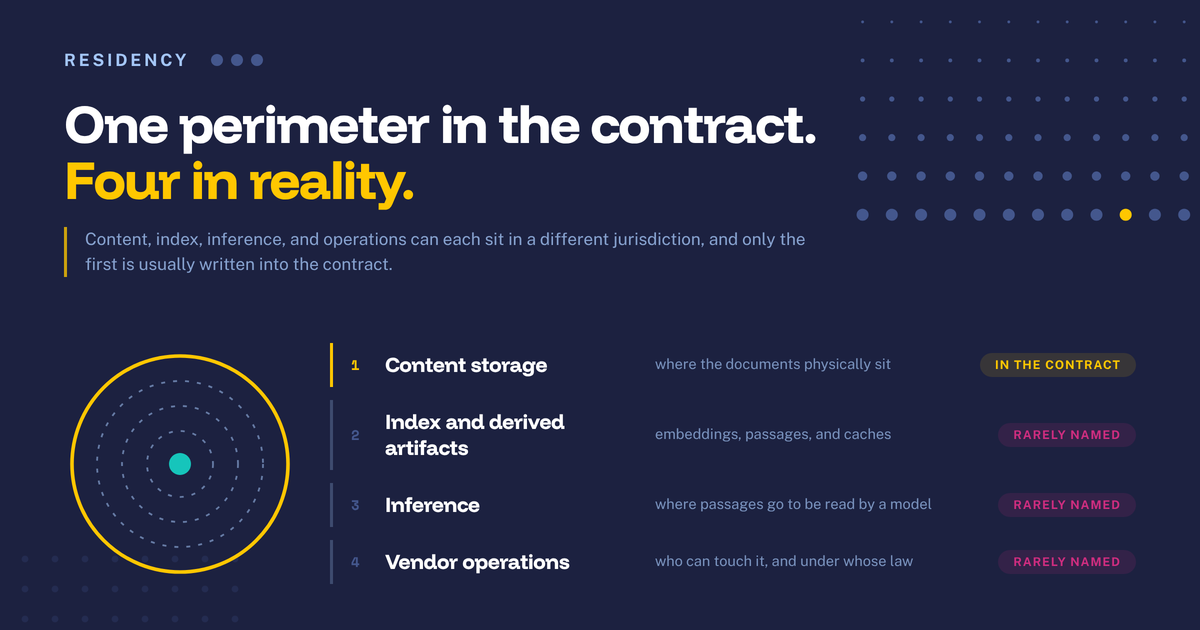
Where a context layer runs decides whether it can be used at all in many regulated settings, and the answer is not one fact but four: where documents are stored, where the index lives, where inference happens, and who has legal authority to compel access. Teams routinely collapse those four into a single question about hosting region, and vendors routinely answer only that one. A deployment that satisfies a data residency clause can still fail a sovereignty review, because the index, the model call, and the vendor’s own operational access each cross a boundary of their own.
For a large share of government and health buyers this is the first filter, asked before retrieval quality, connectors, or price. It is also the least written-about question in a category Forrester has described as the next evolution of semantic layers and knowledge graphs. What follows is the reference: what each boundary means, what moves across it that teams do not expect, what each deployment model actually gives you, and what to ask.
Four different things people mean by “where it runs”
Procurement asks about hosting location. Security asks about tenancy. Legal asks about jurisdiction. Operations asks who at the vendor can log in during an incident. Those are four distinct questions, and a vendor can answer one cleanly while quietly failing the rest.
| Term | The question it answers | Who usually asks it |
|---|---|---|
| Data residency | In what geography does the data physically sit, at rest and in transit, including backups and replicas? | Procurement, privacy office, and contract reviewers |
| Data sovereignty | Whose law governs the data, and which government can compel its disclosure? | General counsel, public sector compliance, and risk committees |
| Tenancy | Is the compute, storage, and index shared with other customers, or dedicated to us alone? | Security architecture and infrastructure review boards |
| Operational access | Which named people at the vendor can see, export, or modify our content, under what controls and what record? | CISO, insider risk teams, and auditors |
Residency is geography, and the easiest of the four to answer incompletely: a primary region commitment says nothing about backups, disaster recovery replicas, or support tooling. Sovereignty is law, and the two come apart more often than people expect. Tenancy is blast radius: a shared index with logical separation is a legitimate design, but it is not the same risk statement as dedicated infrastructure. Operational access decides most security reviews, because it is the only one of the four that involves people rather than diagrams.
A vendor that answers only the first has not answered the question. “Your data stays in your region” is compatible with a shared index, a support team on another continent holding standing read access, and a parent company subject to a government that can compel production. Ask all four, separately, in writing.
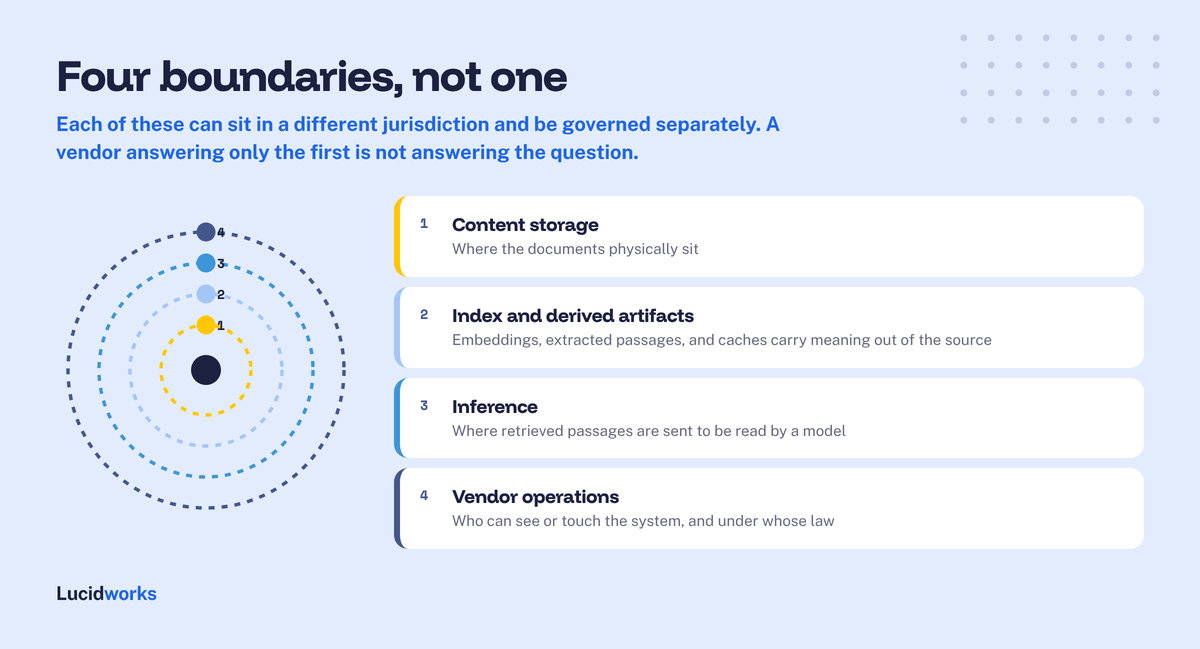
The content is not the only thing that moves
Residency conversations focus on documents, because documents are what the policy names. A context layer also produces derived artifacts that carry meaning out of the source, each with its own location and retention.
- The index contains your content. A search index is not a pointer to documents, it is a copy of them, usually including full text and extracted passages. Wherever the index lives, the content lives.
- Embeddings and extracted passages carry meaning. A vector is a numeric representation of a passage, and an extracted passage is the sensitive paragraph with the surrounding pages stripped away. Both are derivatives and should inherit the source classification.
- Logs and telemetry contain queries. “What is the settlement range in the Dyer matter” is sensitive even if no document comes back. Query logs and prompt traces often flow to a vendor’s observability stack, which may sit in a different region from the index.
- Caches persist answers. Response and semantic caches store generated text assembled from restricted sources, frequently without the permission metadata that governed the original retrieval.
- Backups cross regions. Cross-region replication is a resilience default in most managed services, and it is the most common way a documented residency commitment turns out to be untrue in practice.
One claim deserves emphasis, because the opposite assumption keeps showing up in architecture reviews: an embedding is not anonymization. Embedding inversion research has repeatedly shown that text can often be approximately reconstructed from its vector, and that attributes of the source can be inferred even where exact text cannot. Treating a vector index as non-sensitive, and therefore as something that can sit outside the governed boundary, is a design error. Classify the vector store the way you classify the documents it was built from.
Inference is the part teams forget
Suppose documents never leave, the index never leaves, and logs are contained. The system still has to generate an answer, and that means sending retrieved passages to a model. Those passages are the most sensitive part of the pipeline, because retrieval has already selected the exact text that answers a sensitive question. The content boundary and the inference boundary are separate.
- A hosted commercial model. The strongest capability available, with passages sent to a third-party API. What matters is the contract: processing region, zero-retention terms, whether prompts are used for training, the subprocessor list, and whether the region guarantee covers abuse monitoring and human review as well as inference.
- A model hosted in the customer’s own cloud region. A commercial or open-weights model deployed in the customer’s cloud account, keeping passages inside a known jurisdiction and a known contract while still using managed infrastructure. This is the middle path most regulated buyers settle on.
- A model running inside the customer’s boundary. Open-weights models on the customer’s own hardware. Strongest control, heaviest burden, since the customer now owns model serving, capacity, and upgrades.
The trade is real: the strongest residency posture usually means a smaller or self-hosted model than the largest commercial system. The useful question is not whether you can run the biggest model but which tasks genuinely need it. Summarizing three retrieved paragraphs into a cited answer is a different task from open-ended reasoning, and it is far less sensitive to model size.
This is where retrieval quality earns its keep. For grounded answers, the accuracy of what you put in front of the model usually matters more than the model’s size, because a smaller model given the right passage beats a larger model given the wrong one. That is an engineering argument rather than a consolation prize, and it is why work on semantic search for knowledge management tends to return more than work on model size. Teams with strict residency constraints should spend their effort on chunking, hybrid retrieval, and ranking first.
Deployment models, and what each one actually gives you
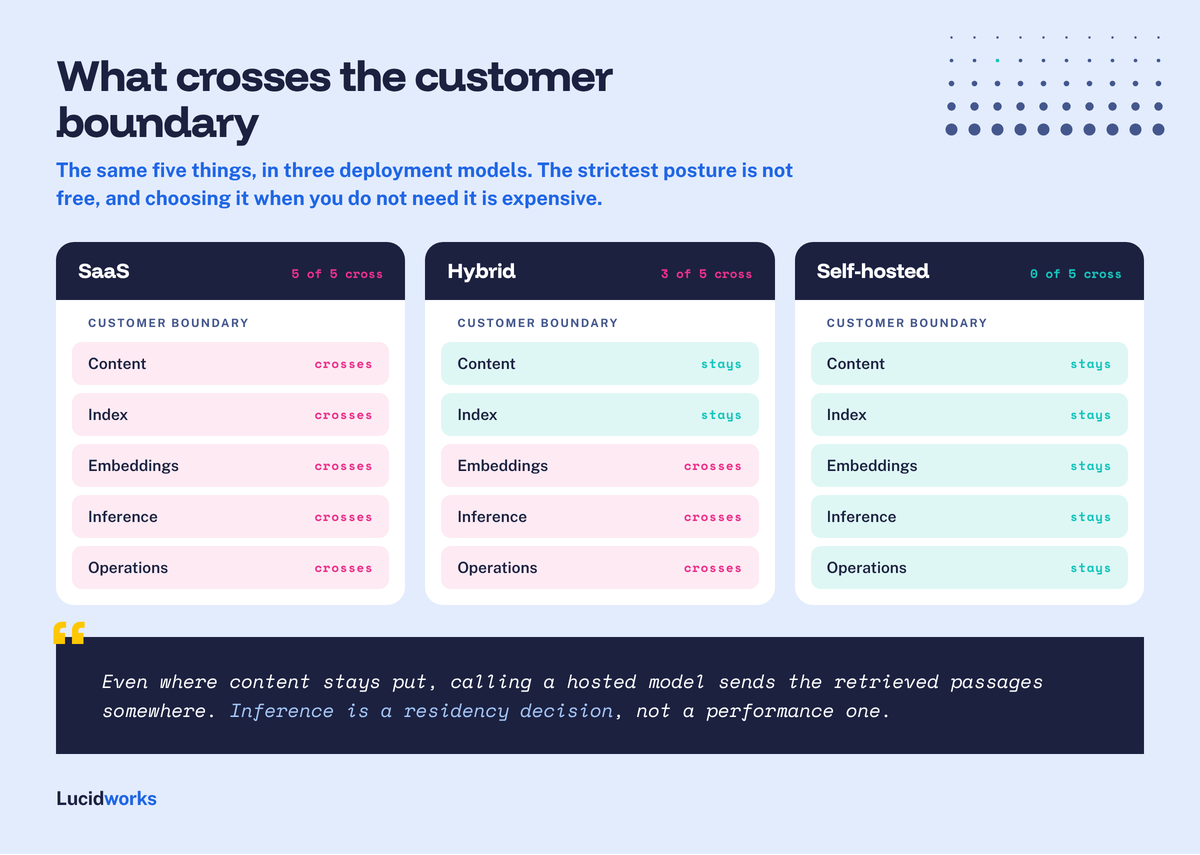
| Dimension | SaaS | Hybrid | Self-hosted |
|---|---|---|---|
| Where content lives | Vendor-operated environment, in a selected region | Split: content and often the index stay with the customer, some services vendor-operated | Entirely in the customer’s environment, cloud or data center |
| Where inference can run | Vendor-managed, or a commercial provider under the vendor’s contract | Customer-chosen for sensitive tasks, vendor-managed for the rest | Customer-chosen, including models inside the customer boundary |
| Who operates it | Vendor: capacity, patching, availability, and upgrades | Both, with a documented split of responsibility | Customer, including scaling, patching, and incident response |
| Upgrade cadence | Continuous, vendor-driven | Mixed: vendor components move faster than customer-operated ones | Customer-scheduled, slower, with a version lag |
| Typical fit | Most commercial buyers, and regulated buyers whose regime allows a compliant vendor environment | A hard constraint on content location, but none on managed control planes | Explicit prohibitions on external processing, or an on-premises mandate |
Lucidworks publishes three platform deployment options: SaaS, Self-Hosted, and Hybrid-SaaS. Lucidworks also publicly lists SOC 2, ISO/IEC 27001:2022, CCPA, and GDPR. Any requirement beyond those, and any specific authorization regime, is a question to put to every vendor on your list, including this one, and to answer with a document rather than a claim on a slide.
Sovereignty is a legal question before it is a technical one
Residency is answered by an architecture diagram. Sovereignty is answered by counsel. The question is which government can lawfully compel a party to produce data, and that depends on where the vendor is incorporated, where it has corporate presence, where its parent and subsidiaries operate, and which staff hold the keys. It does not depend only on where the servers sit. A provider incorporated in one country and operating infrastructure in another is potentially answerable to both.
This is why some buyers require more than in-region infrastructure. They require an in-region legal entity, in-region operational staff, and a commitment that no support engineer outside the jurisdiction holds standing access. It is also why sovereign cloud offerings exist as separate products rather than as a region setting: the differentiator is control and personnel structure, not the data center address. Buyers evaluating search and AI for government agencies usually arrive with this already specified.
To be explicit: this is not legal advice, and these questions are not a compliance assessment. Which regimes apply, what your authorizing environment requires, and whether a given vendor structure satisfies it are determinations for your own counsel. What an architecture team can do is make sure counsel is answering the right question, which means handing them all four boundaries instead of just the hosting region.
What this costs you, honestly
Self-hosting shifts cost from subscription to staff. Someone now owns capacity planning, index operations, GPU scheduling if models run locally, patching, upgrade testing, and on-call. That is a standing allocation of experienced engineers, and it does not end. Feature delivery slows. Customer-scheduled upgrades mean a version lag, and in a category moving this fast, two releases behind is a real capability gap. Hybrid introduces two operational surfaces. You own part of the system and depend on a vendor for the rest, with a boundary both sides have to debug during an incident. Hybrid is often right, but it is not cheap.
Teams routinely underestimate this. The common failure is choosing the strictest posture available rather than the strictest posture required, usually because nobody wanted to argue for less control in a security review. Self-hosting when a compliant managed environment would have satisfied the regime is an expensive mistake that compounds every quarter. Decide from a written requirement, not from a feeling about risk.
The counterweight is that governed does not mean unprofitable. A commissioned Forrester Total Economic Impact study of Lucidworks found 391% ROI over three years with payback in under six months, a measured result for an approach built around permissions, grounding, and evidence. Regulated organizations do run programs like this at scale, and Northwell Health’s search program is a published healthcare example. Control is not free, but the governed path has a measurable return, so the decision can rest on requirements and economics rather than fear.
Questions to put to any context layer vendor
Each of these should be answerable with a region name, a document, a number, or a list. A reassurance is a failed answer.
- In which regions does content sit at rest, and where do backups, replicas, and disaster recovery copies sit?
- Where is the index stored, and is it in the same region and tenancy as the source content?
- Is the index dedicated to us or shared under logical separation, component by component?
- Where are embeddings generated and stored, and are they ever processed outside the source content’s region?
- Where do query logs, prompt traces, and product telemetry go, how long are they kept, and can we turn them off?
- Which model providers can be called in each deployment model, and can inference be restricted to a region or to models inside our boundary?
- What are the retention and training terms for any third-party model called on our behalf, and what is the subprocessor list?
- Which named roles at your company hold standing access to our content, and what approval and logging covers it?
- Can you contractually restrict all support and operations personnel who can reach our environment to our jurisdiction?
- Where is your company incorporated, and which entities in your structure could be compelled to produce our data?
- In a self-hosted deployment, what still calls out to you (license checks, telemetry, model routing, updates), and can each be disabled?
- What is the current version lag for self-hosted customers, and what is the supported upgrade and end-of-support policy?
Lucidworks approaches this through an AI Context Data Platform: permissions ingested with the content and checked at query time, retrieval and grounding over unstructured enterprise content, and a record of what was asked, retrieved, and answered, in whichever published deployment model fits the constraint. The questions above still apply, and should be put to us in the same words as to everyone else.
Frequently asked questions
Can regulated industries use a vendor’s cloud at all?
As a matter of law, usually yes, and that is worth separating from what a given institution will approve. HHS states that a covered entity or business associate may use a cloud service to store or process protected health information, provided a HIPAA business associate agreement is in place. FedRAMP exists specifically to authorize cloud services that handle unclassified federal information. Financial regulators set conditions on cloud use rather than prohibiting it. What is true is that many individual institutions prohibit it by internal policy, that some contracts and national regimes do, and that the approval path can be long enough that teams choose self-hosting to avoid it entirely. So when someone says the data cannot go to a vendor cloud, ask which document says so, and read what it actually names: content, processing, operators, or jurisdiction. The answer decides which deployment model you need, and it is frequently narrower than the blanket version.
Is a private cloud the same as self-hosted?
No. Private cloud usually means dedicated infrastructure that the vendor or a cloud provider still operates, which addresses tenancy but leaves operational access and often jurisdiction unchanged. Self-hosted means your team runs the software in your own environment and controls who can reach it. If the requirement is that no vendor personnel can access your data, private cloud alone does not satisfy it.
Do embeddings count as personal data?
There is a serious argument that they can. Embeddings are derived from source text, inversion research shows text can often be approximately recovered from them, and several privacy regimes define personal data broadly enough to cover information from which an individual is identifiable indirectly. This is not settled uniformly, so treat the vector store at the classification of its source content and let counsel make the formal determination.
Can we use a commercial model and still meet residency requirements?
Sometimes. It depends on whether the provider offers inference in your required region, whether retention and training terms are contractually zero for your data, and whether ancillary pipelines such as abuse monitoring and human review stay in region as well. That last detail is the one most often missed, because it sits outside the main inference path. Get it in the contract or the data processing addendum, not from documentation that can change.
Does keeping content in region make us sovereign?
No. Residency is geography, sovereignty is law, and a vendor subject to another government’s jurisdiction can potentially be compelled regardless of where the servers sit. Sovereignty claims rest on corporate structure, personnel location, and key control as much as on infrastructure. Treat an in-region commitment as necessary and not sufficient.
What usually breaks a residency commitment in practice?
Backups and replication first, then telemetry. Cross-region replication is a default in many managed services, and observability pipelines are often centralized in one region for the whole vendor. Caches and support tooling come next. Ask for the full data flow map, including non-production environments, since that is where copies of production content most often end up.
How do we choose between hybrid and fully self-hosted?
Write down the specific prohibition you are trying to satisfy and see whether it names content, processing, or operators. If the constraint is on where content and inference happen, hybrid usually satisfies it at a fraction of the operating cost. If no external party may operate any part of the system, or you have an on-premises mandate, hybrid will not survive review.