
Enterprise Search Is Becoming the AI Infrastructure Layer for Modern Enterprises

Executive Summary
For decades, enterprise search was treated as a feature.
Employees used it to locate documents.
Customers used it to find products.
Knowledge workers used it to navigate repositories.
Search was important—but rarely strategic.
That era is ending.
As organizations invest in generative AI, AI assistants, Retrieval-Augmented Generation (RAG), and AI agents, a new reality is emerging:
The future of enterprise AI depends on retrieval.
And retrieval depends on enterprise search.
The companies succeeding with AI today are discovering that the challenge isn’t selecting a large language model. It isn’t building a chatbot. It isn’t even deploying AI agents.
The challenge is helping AI find the right information at the right time.
Enterprise search is rapidly evolving from a user-facing application into the retrieval infrastructure layer that powers enterprise AI.
In this article, we’ll explore:
- Why retrieval is becoming the bottleneck for enterprise AI
- Why search matters more in the AI era—not less
- The relationship between enterprise search, RAG, and AI agents
- Why hybrid search has become foundational
- How enterprise search is evolving into enterprise intelligence infrastructure
- What business leaders should do next
Quick Answers
| Question | Short Answer |
|---|---|
| Is enterprise search still important in the age of AI? | Yes. Enterprise search is becoming more important because AI depends on retrieval. |
| What is AI infrastructure? | AI infrastructure includes the systems that provide models, data, retrieval, security, and orchestration for AI applications. |
| Why is enterprise search becoming AI infrastructure? | It provides the retrieval, security, connectors, and knowledge access AI systems require. |
| Does RAG replace enterprise search? | No. RAG depends on enterprise search capabilities. |
| Do AI agents need enterprise search? | Yes. Most enterprise AI agents rely on a retrieval infrastructure to access information and take action. |
The Enterprise AI Reality Nobody Talks About
Most AI conversations focus on models.
- GPT.
- Claude.
- Gemini.
- Llama.
- Mistral.
Every week, organizations evaluate new models, benchmark performance, and compare capabilities.
Yet a surprising number of enterprise AI projects encounter the same problem:
The model isn’t the bottleneck.
Information access is.
- An AI assistant can only answer questions using information it can access.
- An AI agent can only make decisions using information it can retrieve.
- A generative AI application can only be as accurate as the information it receives.
- When information is fragmented across dozens of systems, even the most sophisticated AI struggles.
This is where enterprise search enters the picture.
AI Has Created a Retrieval Problem
Most enterprises contain enormous amounts of information.
Examples include:
- Product catalogs
- Technical documentation
- SharePoint repositories
- Confluence pages
- CRM systems
- ERP systems
- Customer support records
- Engineering documents
- Service manuals
- Policy libraries
Historically, humans searched these systems.
Today, humans and machines both need access.
That shift changes everything.
- The volume of retrieval requests is increasing.
- The complexity of retrieval is increasing.
- The importance of retrieval is increasing.
AI has transformed search from a convenience into a critical business capability.
Why Enterprise Search Matters More Than Ever
For years, enterprise search focused primarily on helping people find information.
Now it must help people and machines.
Consider a modern enterprise environment.
- Employees need answers.
- Customers need answers.
- Partners need answers.
- AI assistants need answers.
- AI agents need answers.
Every one of these experiences begins with retrieval.
The more AI an organization deploys, the more important retrieval becomes.
Search is no longer just supporting business processes.
Search is increasingly powering them.
Enterprise Search Is the Foundation of RAG
Retrieval-Augmented Generation has become one of the most widely adopted enterprise AI architectures.
The reason is simple.
Organizations need AI systems that can access current, enterprise-specific information.
RAG solves this challenge by retrieving information before generating a response.
The workflow typically looks like this:
- User asks a question
- Relevant content is retrieved
- Retrieved content is supplied to an LLM
- The model generates an answer
The key insight is often overlooked.
The quality of the answer depends heavily on the quality of retrieval.
Poor retrieval produces poor answers.
Strong retrieval produces better answers.
Enterprise search provides many of the capabilities RAG depends on:
- Connectors
- Indexing
- Metadata enrichment
- Permissions
- Relevance ranking
- Analytics
This is why enterprise search and RAG are complementary technologies rather than competing ones.
AI Agents Increase the Importance of Search
The next wave of enterprise AI is increasingly agentic.
Unlike chatbots, AI agents perform tasks.
Examples include:
Procurement Agents
Researching products and suppliers.
Customer Service Agents
Resolving issues.
IT Support Agents
Troubleshooting problems.
HR Assistants
Answering policy questions.
Manufacturing Assistants
Locating technical documentation.
Before agents can act, they must understand context.
To understand context, they need retrieval.
An AI agent searching for information may need to:
- Query multiple systems
- Access product data
- Retrieve documentation
- Verify permissions
- Analyze historical records
This is fundamentally a search problem.
As organizations deploy more agents, enterprise search becomes increasingly strategic.
In many environments, AI agents may ultimately generate more retrieval requests than human users.
The Rise of Enterprise AI Search

Enterprise AI search represents the convergence of search and artificial intelligence.
Traditional search systems focused on returning documents.
Modern AI search systems increasingly deliver:
- Answers
- Summaries
- Recommendations
- Actions
The underlying retrieval challenge remains.
The difference is how information is presented.
Modern enterprise AI search often combines:
Lexical Search
Exact matching.
Semantic Search
Meaning-based retrieval.
Machine Learning
Relevance optimization.
Personalization
Context-aware experiences.
Generative AI
Answer generation.
The result is a more intelligent discovery experience.
Why Hybrid Search Has Become Foundational
One of the biggest lessons from enterprise AI deployments is that semantic search alone is not enough.
Enterprise environments contain information that requires precision.
Examples include:
- Part numbers
- Product IDs
- Regulatory references
- Customer identifiers
- Technical specifications
A search for:
“AB-1234”
requires exact retrieval.
A search for:
“What replacement valve works with this assembly?”
benefits from semantic retrieval.
This is why hybrid search has become foundational.
Hybrid search combines:
Lexical Search
Precision.
Semantic Search
Understanding.
Together, they create a stronger retrieval infrastructure for AI applications.
Organizations pursuing enterprise AI should view hybrid retrieval as a strategic requirement.
Enterprise Search Is Becoming Enterprise Intelligence Infrastructure
Historically, enterprise search sat at the edge of enterprise architecture.
It was a destination users visited when they needed information.
Today, enterprise search is moving toward the center.
Increasingly, search powers:
- Knowledge management
- Digital commerce
- Customer service
- AI assistants
- RAG architectures
- AI agents
- Enterprise decision-making
This evolution changes how leaders should think about search.
Search is no longer a tool.
Search is becoming infrastructure.
In the same way databases became foundational to applications, retrieval is becoming foundational to AI.
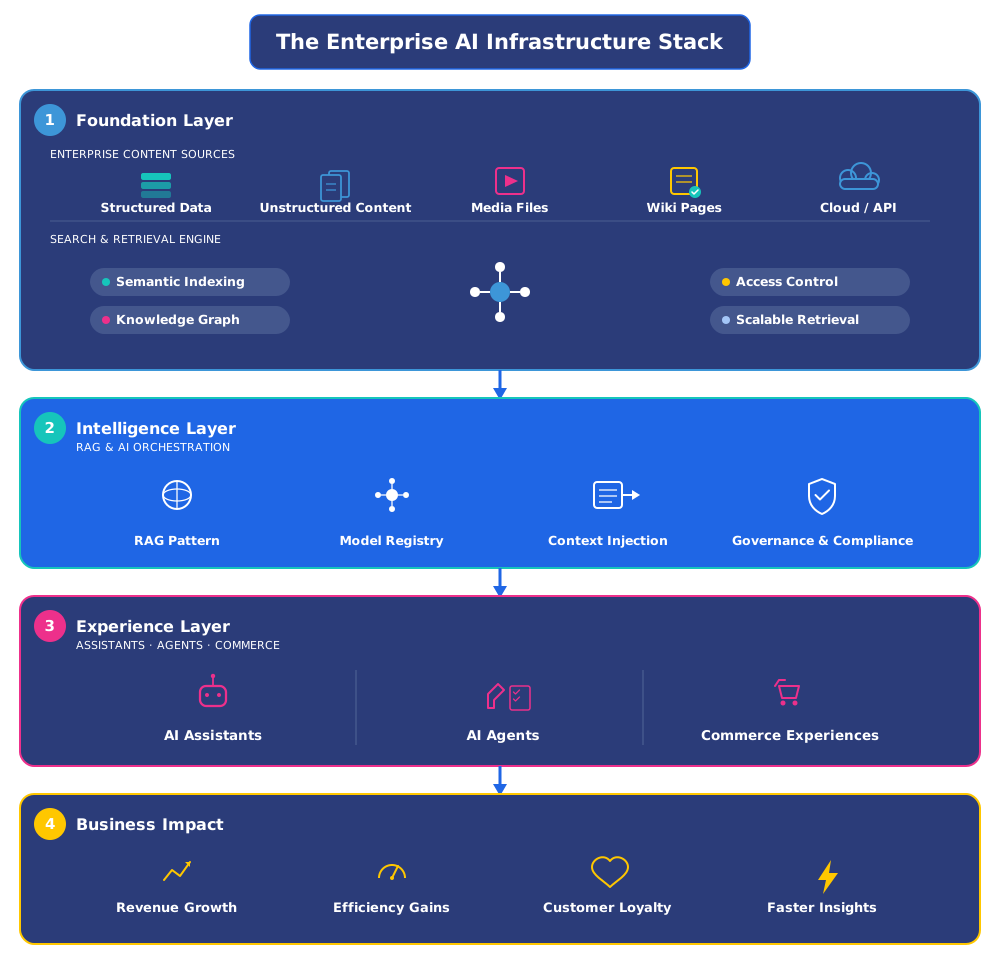
The New Enterprise AI Stack
Many organizations are unknowingly building a new technology stack.
A simplified version often looks like this:
Enterprise Content
Documents, products, records, knowledge.
↓
Enterprise Search
Retrieval and relevance.
↓
AI Layer
LLMs, RAG, orchestration.
↓
Experience Layer
Assistants, agents, applications, workflows.
In this architecture, enterprise search sits between enterprise knowledge and enterprise AI.
It becomes the bridge connecting information and intelligence.
What Enterprise Leaders Should Evaluate
Organizations investing in AI should evaluate retrieval infrastructure as carefully as they evaluate models.
Important considerations include:
Retrieval Quality
Can users and AI consistently find the right information?
Connector Ecosystem
Can the platform access critical enterprise systems?
Security
Can permissions and governance be enforced?
Hybrid Search
Can the platform support both exact and semantic retrieval?
AI Readiness
Can it support RAG and AI agents?
Analytics
Can teams continuously improve performance?
Scalability
Can the platform support growing AI workloads?
The strongest AI outcomes often come from organizations with the strongest retrieval foundations.
The Future of Enterprise Search
The next decade will likely redefine enterprise search.
Search experiences will become:
- More conversational
- More personalized
- More proactive
- More agent-driven
Yet the fundamental challenge remains unchanged.
Information must still be found.
Knowledge must still be retrieved.
Context must still be delivered.
The future of AI will not reduce the importance of enterprise search.
It will dramatically increase it.
The organizations that recognize this shift early will be better positioned to scale AI initiatives, improve customer experiences, accelerate employee productivity, and unlock the value of enterprise knowledge.
Key Takeaways
- AI is increasing the importance of retrieval.
- Enterprise search provides the foundation for enterprise AI.
- RAG depends on enterprise search capabilities.
- AI agents require retrieval to operate effectively.
- Hybrid search has become foundational infrastructure.
- Enterprise search is evolving from a feature into a strategic platform.
- The future of enterprise AI depends on access to enterprise knowledge.
Enterprise search is no longer simply helping users find information.
It is becoming the infrastructure layer that powers the next generation of enterprise intelligence.
Frequently Asked Questions (FAQ): Enterprise Search as AI Infrastructure
Why is enterprise search becoming AI infrastructure?
Enterprise search provides the retrieval, relevance, security, and knowledge-access capabilities that AI systems require.
What is retrieval infrastructure?
Retrieval infrastructure includes the technologies responsible for finding, ranking, securing, and delivering information.
Does enterprise search support RAG?
Yes. Enterprise search often serves as the retrieval layer for RAG systems.
Why do AI agents need enterprise search?
AI agents rely on retrieval to access information and understand context before taking action.
What is enterprise AI search?
Enterprise AI search combines traditional search, semantic retrieval, machine learning, and generative AI.
What is hybrid search?
Hybrid search combines lexical and semantic retrieval to improve relevance.
Is semantic search enough for enterprise AI?
Most organizations achieve better outcomes using hybrid search rather than semantic search alone.
What should enterprises evaluate when building AI systems?
Organizations should evaluate retrieval quality, connectors, security, AI readiness, analytics, and scalability.
Can enterprise search improve knowledge management?
Yes. Enterprise search helps users and AI systems discover knowledge across repositories and applications.
What industries benefit most from enterprise AI search?
Manufacturing, B2B commerce, government, financial services, healthcare, technology, and knowledge-intensive organizations benefit significantly.
Ready to Build the Retrieval Foundation for Enterprise AI?
Whether you’re deploying AI assistants, implementing RAG, enabling AI agents, modernizing knowledge management, or improving digital commerce, success depends on retrieval.
See how Lucidworks helps organizations create the enterprise search foundation that powers modern AI experiences, enterprise intelligence, and agentic workflows.
<<< Book a Demo >>>