
Enterprise Search for B2B Commerce: The New Competitive Advantage for Manufacturers and Distributors

Executive Summary
For years, B2B commerce leaders were told to learn from B2C ecommerce.
Improve the user experience.
Simplify navigation.
Make products easier to find.
Those lessons were valuable—but they were never enough.
A consumer searching for a pair of shoes and an industrial buyer sourcing a hydraulic assembly are solving fundamentally different problems.
B2B buyers operate in a world of:
- Complex product catalogs
- Technical specifications
- Product compatibility requirements
- Negotiated pricing
- Industry-specific terminology
- Repeat purchasing patterns
- Multi-step approval workflows
As B2B buying increasingly moves online, enterprise search has become one of the most important technologies driving digital revenue.
Today’s buyers expect immediate answers, intelligent product discovery, self-service purchasing, and AI-assisted recommendations. When the search fails, revenue is lost.
Modern enterprise search platforms help manufacturers, distributors, and B2B sellers connect buyers with products, content, specifications, inventory, and expertise—while creating the retrieval foundation for AI-powered commerce experiences.
In this article, we’ll explore:
- Why B2B commerce search is different
- The hidden revenue impact of poor search
- How enterprise search improves product discovery
- Why AI is changing B2B buying
- The rise of agentic commerce
- What B2B organizations should look for in enterprise search software
Quick Answers
| Question | Short Answer |
|---|---|
| Why is enterprise search important for B2B commerce? | It helps buyers find products, specifications, inventory, and answers more quickly, improving revenue and customer satisfaction. |
| How is B2B commerce search different from retail search? | B2B buyers deal with technical products, complex catalogs, compatibility requirements, and account-specific information. |
| What is B2B product discovery? | The process of helping buyers find and evaluate products through search, navigation, recommendations, and AI-assisted experiences. |
| Can AI replace B2B commerce search? | No. AI depends on search and retrieval infrastructure to access product and content information. |
| What is agentic commerce? | Agentic commerce uses AI agents to help buyers research, compare, and purchase products. |
B2B Commerce Has Changed Forever
The modern B2B buyer behaves differently from how buyers did even five years ago.
Research consistently shows buyers prefer to complete significant portions of the buying journey independently.
Before contacting sales, buyers often want to:
- Research products
- Compare alternatives
- Review specifications
- Understand compatibility
- Access documentation
- Evaluate pricing
- Check availability
In many organizations, buyers may complete 70–80% of the journey before engaging with a salesperson.
The implication is clear:
If buyers cannot find information digitally, they may never reach sales at all.
Search has become one of the most important drivers of digital revenue.
Why B2B Commerce Search Is Different
Many e-commerce platforms were originally designed around consumer experiences.
B2B buying introduces entirely different challenges.
Consider the difference.
A consumer might search:
“running shoes”
A B2B buyer might search:
“3-inch stainless butterfly valve compatible with food-grade processing systems.”
One query is simple.
The other requires technical understanding, compatibility information, and precise retrieval.
B2B organizations often manage:
- Millions of SKUs
- Technical specifications
- Product relationships
- Contract pricing
- Inventory data
- Compliance information
- Product documentation
Finding the right answer becomes much more difficult.
Enterprise search helps solve this complexity.
The Hidden Cost of Poor Search
Many organizations underestimate how much revenue depends on search quality.
When buyers cannot find products, they rarely submit a support ticket explaining why.
They simply leave.
This creates invisible revenue leakage.
Common consequences include:
Product Abandonment
Buyers fail to locate the correct product.
Reduced Conversion
Buyers become frustrated during discovery.
Increased Sales Friction
Sales teams answer questions that could have been self-serve.
Higher Support Costs
Support teams spend time helping buyers locate information.
Lower Customer Satisfaction
Customers expect better experiences.
In B2B commerce, improving search often delivers measurable business outcomes.
Search Is the Front Door to Revenue
For many manufacturers and distributors, search has become the most important digital touchpoint.
When buyers arrive at a website, they generally follow one of two paths:
Navigation
Browsing categories.
Search
Searching directly for products or answers.
High-intent buyers frequently choose search.
These buyers often know:
- What problem are they solving
- What product do they need
- What specifications matter
Search sits directly in the path of purchase.
Improving search can improve:
- Revenue
- Conversion rates
- Average order value
- Customer satisfaction
- Self-service adoption
The Product Discovery Challenge
Search alone is not enough.
Modern B2B commerce requires product discovery.
Product discovery helps buyers answer questions such as:
- Which product is right for me?
- What alternatives exist?
- What products are compatible?
- What products are commonly purchased together?
- What should I buy next?
This requires more than retrieval.
It requires understanding.
Modern enterprise search platforms increasingly combine:
- Search
- Recommendations
- Personalization
- AI ranking
- Behavioral analytics
to improve discovery experiences.
Why Part Numbers Still Matter
One of the biggest mistakes vendors make is assuming B2B commerce is becoming entirely semantic.
Part numbers remain critical.
Examples:
- AB-1234
- HCV-4400
- 16AXL-778B
A buyer searching for these products expects exact retrieval.
Not something similar.
Not a recommendation.
The exact product.
This is why lexical search remains essential.
The best B2B commerce experiences combine:
Exact Retrieval
For known-item searches.
Semantic Retrieval
For exploratory discovery.
The result is a hybrid search.
Why Hybrid Search Has Become the Standard
Hybrid search combines:
Lexical Search
Exact keyword matching.
Ideal for:
- Part numbers
- Product IDs
- Technical specifications
- Known-item searches
Semantic Search
Meaning-based retrieval.
Ideal for:
- Natural language queries
- Product exploration
- Technical research
- Discovery experiences
Together, these approaches produce stronger results than either technique alone.
For complex B2B catalogs, hybrid search is increasingly considered a requirement rather than a luxury.
Enterprise Search Powers B2B Commerce AI
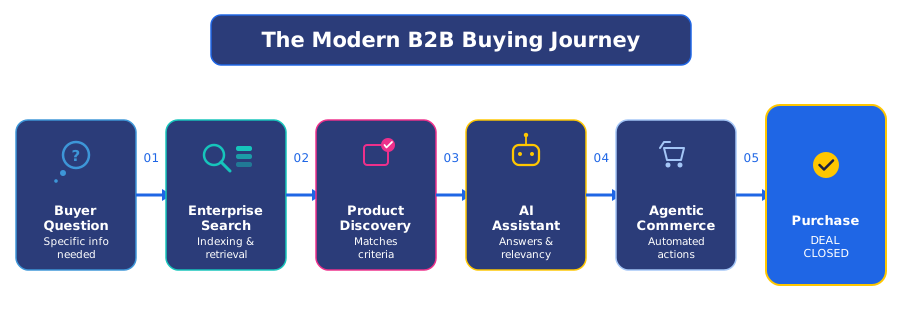
Many organizations are deploying AI across commerce experiences.
Examples include:
- Shopping assistants
- Product recommendation engines
- Technical support assistants
- Quoting assistants
- Procurement assistants
These experiences depend on retrieval.
Before AI can answer a question, it must locate information.
That information may exist in:
- Product catalogs
- ERP systems
- PIM systems
- Knowledge bases
- Technical documentation
- Inventory systems
Enterprise search provides the retrieval infrastructure that powers AI commerce.
Without retrieval, AI lacks context.
Without context, AI struggles to provide accurate recommendations.
The Rise of Agentic Commerce
The next evolution of B2B commerce is agentic commerce.
Instead of simply answering questions, AI agents help buyers complete tasks.
Examples include:
Product Research
Finding compatible products.
Technical Evaluation
Reviewing specifications.
Procurement Assistance
Comparing alternatives.
Replenishment
Identifying replacement products.
Guided Selling
Helping buyers navigate complex decisions.
Every one of these experiences depends on retrieval.
Agentic commerce increases the importance of enterprise search rather than reducing it.
B2B Commerce Use Cases for Enterprise Search
Product Discovery
Helping buyers locate relevant products.
Part Number Search
Retrieving exact products using identifiers.
Guided Selling
Helping buyers make informed decisions.
Compatibility Search
Finding products that work together.
Technical Documentation Search
Locating specifications, manuals, and installation guides.
Distributor Enablement
Helping channel partners access information.
Self-Service Support
Reducing support burden while improving customer experiences.
AI Commerce Experiences
Providing retrieval infrastructure for AI assistants and agents.
What B2B Commerce Leaders Should Look For
Not all search platforms are designed for B2B complexity.
Organizations should evaluate solutions across several dimensions.
Exact-Match Search
Can the platform retrieve part numbers accurately?
Hybrid Search
Can it combine lexical and semantic retrieval?
Product Discovery
Can it support recommendations and guided discovery?
Catalog Scale
Can it handle millions of products?
AI Readiness
Can it support RAG and AI-powered experiences?
Personalization
Can experiences adapt to users and accounts?
Analytics
Can teams continuously improve performance?
Deployment Flexibility
Can the platform support enterprise requirements?
Why Search Is Becoming a Competitive Advantage
Most manufacturers and distributors already offer digital commerce.
Fewer provide exceptional discovery experiences.
As product catalogs become larger and buying journeys become more self-directed, search increasingly determines:
- Which products are found
- Which products are purchased
- Which buyers convert
- Which customers remain loyal
Search is no longer a utility.
It is becoming a competitive advantage.
Organizations that help buyers find answers faster create better customer experiences and stronger business outcomes.
The Future of Enterprise Search in B2B Commerce
The future of B2B commerce will be shaped by three major trends.
AI-Assisted Buying
Buyers will increasingly expect conversational experiences.
Agentic Commerce
AI agents will assist buyers throughout purchasing journeys.
Intelligent Discovery
Search experiences will evolve from retrieval to recommendation and guidance.
Yet every one of these trends depends on a common foundation:
Retrieval.
The organizations that succeed will not simply have larger catalogs.
They will have more discoverable catalogs.
They will make it easier for buyers, sellers, distributors, and AI systems to find information.
Enterprise search will increasingly serve as the infrastructure layer that powers those experiences.
Key Takeaways
- B2B commerce search is fundamentally different from retail search.
- Search quality directly impacts revenue and conversion.
- Product discovery is becoming as important as retrieval.
- Part numbers remain critical in B2B environments.
- Hybrid search has emerged as the preferred architecture.
- AI and agentic commerce depend on enterprise search.
- Search is evolving into a competitive advantage for manufacturers and distributors.
Organizations investing in digital commerce should view enterprise search not as a feature, but as strategic infrastructure.
The future of B2B buying depends on discoverability.
And discoverability starts with enterprise search.
Frequently Asked Questions (FAQ): Enterprise Search for B2B Commerce
Why is enterprise search important for B2B commerce?
Enterprise search helps buyers find products, specifications, inventory, documentation, and answers more efficiently.
How is B2B commerce search different from retail search?
B2B buyers often navigate technical products, complex catalogs, compatibility requirements, and account-specific information.
What is product discovery?
Product discovery helps buyers find, evaluate, compare, and select products through search, recommendations, and AI-assisted experiences.
What is hybrid search?
Hybrid search combines exact keyword retrieval with semantic search to improve relevance.
Why are part numbers important?
Many B2B buyers search using exact product identifiers and expect precise results.
Can AI replace enterprise search?
No. AI depends on enterprise search to retrieve information and provide accurate responses.
What is agentic commerce?
Agentic commerce uses AI agents to help buyers research, compare, evaluate, and purchase products.
What should organizations look for in B2B commerce search software?
Organizations should evaluate exact-match retrieval, hybrid search, scalability, personalization, analytics, AI readiness, and product discovery capabilities.
Ready to Improve B2B Product Discovery?
Whether you’re helping buyers navigate complex catalogs, improving self-service experiences, enabling AI commerce initiatives, or modernizing digital commerce, enterprise search can help transform discovery into a competitive advantage.
See how Lucidworks helps manufacturers, distributors, and B2B commerce organizations deliver better product discovery, stronger relevance, and AI-powered buying experiences.