
Enterprise Search for Manufacturing: Solving the Part Number Problem in the Age of AI

Executive Summary
Manufacturing companies face a search challenge that most software vendors don’t fully understand.
A retail shopper searching for “blue running shoes” is very different from a maintenance engineer searching for “AB-1234 stainless compression fitting.”
A procurement manager is trying to source a replacement hydraulic valve. A distributor searching through millions of industrial products. A field technician is trying to locate the latest installation guide. An engineer looking for specifications buried in thousands of technical documents.
These are manufacturing search problems.
And they’re becoming more important as manufacturers invest in self-service commerce, digital transformation, AI assistants, and agentic workflows.
The challenge is that many modern search platforms were designed for consumer-style experiences and struggle with the exact-match precision, technical complexity, and structured data requirements common in manufacturing environments.
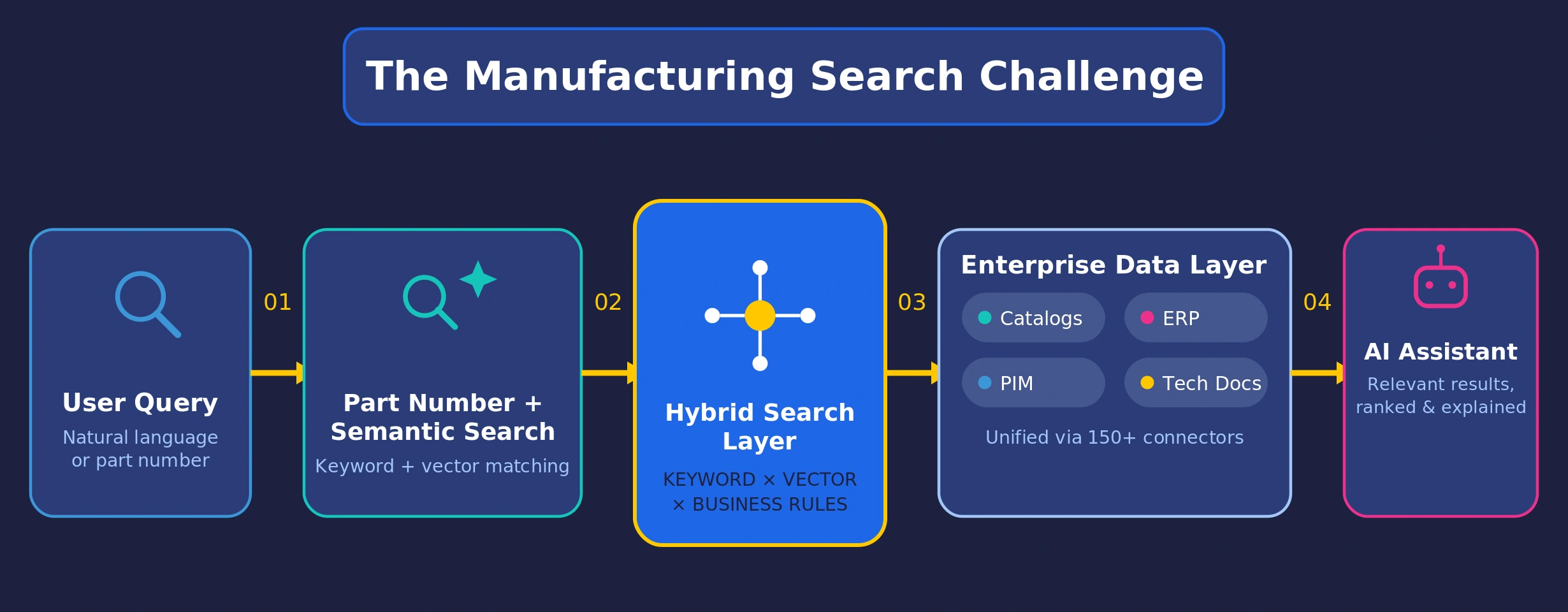
Modern enterprise search platforms combine lexical search, semantic search, hybrid retrieval, AI, and product discovery capabilities to help manufacturers connect employees, distributors, customers, and AI systems with the information they need.
In this article, we’ll explore:
- Why manufacturing search is uniquely difficult
- The hidden cost of poor search experiences
- Why part number search remains critical
- How AI is changing manufacturing discovery
- Why hybrid search is becoming the industry standard
- What manufacturers should look for in enterprise search software
Quick Answers
| Question | Short answer |
|---|---|
| Why is enterprise search important for manufacturing? | It helps employees, distributors, customers, and AI systems quickly find products, specifications, documents, and technical information. |
| What is part number search? | The ability to accurately retrieve products and information using exact identifiers, SKUs, and manufacturer part numbers. |
| Why does manufacturing search differ from retail search? | Manufacturing requires exact-match precision, technical content retrieval, compatibility information, and complex catalog navigation. |
| What is hybrid search in manufacturing? | Hybrid search combines exact keyword retrieval with semantic search to improve relevance. |
| Can AI replace manufacturing search? | No. AI depends on a strong search and retrieval infrastructure. |
Manufacturing Search Is Different
Many search vendors approach manufacturing as if it were simply another form of e-commerce.
It isn’t.
Manufacturing organizations manage a level of complexity that most consumer businesses never encounter.
A typical manufacturer may maintain:
- Millions of SKUs
- Product specifications
- CAD drawings
- Engineering documents
- Safety documentation
- Installation guides
- Service manuals
- Technical bulletins
- Dealer content
- Distributor content
- Compliance documentation
The challenge isn’t simply storing this information.
The challenge is making it discoverable.
When a user cannot find the right product, document, specification, or answer, the business impact can be significant.
Lost productivity.
Longer sales cycles.
Increased support costs.
Missed revenue opportunities.
Poor customer experiences.
Manufacturing search is fundamentally a retrieval problem.
The Part Number Problem
If there is one challenge that defines manufacturing search, it is part number retrieval.
Most modern search discussions focus on:
- Semantic search
- Natural language processing
- AI assistants
- Generative AI
All important capabilities.
Yet many manufacturing organizations still depend on exact-match retrieval.
Consider these examples:
- AB-1234
- 16-AXL-778B
- HCV-4400
- M12X1.75-STL
These identifiers represent real products.
When a buyer searches for them, they expect precision.
Not something similar.
Not something related.
The exact product.
Many AI-first search approaches struggle here because they prioritize conceptual understanding over exact retrieval.
Manufacturers require both.
This is why lexical search remains critically important.
The Hidden Cost of Poor Manufacturing Search
Poor search experiences create measurable business consequences.
Lost Revenue
When buyers cannot find products, they often abandon the purchase process.
In manufacturing environments, the value of a single lost transaction can be substantial.
A missed replacement component may represent:
- Thousands of dollars
- Tens of thousands of dollars
- Long-term customer relationships
Search directly impacts revenue.
Increased Support Costs
Many manufacturers unintentionally force customers to contact support because information is difficult to find.
Support teams often answer questions that could have been self-served if information were more discoverable.
Examples include:
- Product compatibility
- Installation instructions
- Technical specifications
- Warranty information
- Replacement part identification
Enterprise search reduces these support burdens.
Reduced Employee Productivity
Employees experience the same challenges as customers.
- Engineering teams.
- Customer service teams.
- Field technicians.
- Sales representatives.
- Procurement teams.
All rely on information discovery.
When search fails, productivity suffers.
Why Manufacturing Search Has Become More Important
Several industry trends are increasing the importance of search.
Self-Service Buying
Modern buyers increasingly prefer self-service experiences.
Research consistently shows B2B buyers want to complete more of the buying journey independently.
This is especially true for repeat purchases and replacement components.
Search becomes a critical part of the buying experience.
Growing Product Complexity
Manufacturers continue expanding product portfolios.
Catalogs often contain:
- Millions of products
- Thousands of attributes
- Multiple compatibility relationships
Discovery becomes increasingly difficult.
Knowledge Workforce Challenges
Many manufacturers face workforce transitions as experienced employees retire.
Enterprise knowledge often resides in:
- Documents
- Technical manuals
- Service records
- Engineering systems
Enterprise search helps preserve and expose institutional knowledge.
Enterprise AI Adoption
Manufacturers are increasingly deploying:
- AI assistants
- Knowledge assistants
- Technical support bots
- Agentic workflows
All depend on retrieval.
Search is becoming a foundational AI infrastructure.
Manufacturing Search Requires More Than Semantic Search
Semantic search is valuable.
It helps users search naturally.
A user might ask:
“What stainless fitting works with this assembly?”
Instead of knowing an exact product number.
Semantic retrieval helps answer that question.
However, manufacturing environments require more than semantics.
A buyer searching:
“AB-1234”
expects exact retrieval.
An engineer searching:
“M12X1.75”
expects exact retrieval.
A service technician searching:
“Hydraulic Pump Model 4400”
expects exact retrieval.
This is why hybrid search is rapidly becoming the preferred architecture.
Why Hybrid Search Is Becoming the Manufacturing Standard
Hybrid search combines:
Lexical Search
Keyword and exact-match retrieval.
Critical for:
- Part numbers
- Product IDs
- Specifications
- Technical identifiers
Semantic Search
Meaning-based retrieval.
Critical for:
- Natural language questions
- Concept discovery
- Product exploration
- Technical research
Together, they create better relevance than either approach alone.
Manufacturers increasingly recognize that exact retrieval and semantic retrieval are complementary.
Not competing approaches.
Enterprise Search and Manufacturing AI

Manufacturers are investing heavily in AI.
Examples include:
- Technical support assistants
- Engineering knowledge assistants
- Distributor support agents
- Procurement assistants
- Maintenance assistants
All of these systems depend on retrieval.
Before AI can answer questions, it must locate information.
That information may exist in:
- Product catalogs
- Engineering systems
- ERP platforms
- Technical documentation
- Knowledge repositories
Enterprise search provides the retrieval layer that powers manufacturing AI.
Without retrieval, AI cannot reliably answer questions.
Manufacturing Use Cases for Enterprise Search
Product Discovery
Helping buyers locate products across large catalogs.
Part Number Search
Retrieving exact products using identifiers.
Technical Documentation Search
Finding specifications, manuals, and engineering documents.
Compatibility Search
Helping users determine compatible products and replacement components.
Distributor Enablement
Improving information access for channel partners.
Customer Self-Service
Reducing support burden while improving customer experiences.
Engineering Knowledge Discovery
Helping engineers locate expertise and technical information.
AI Assistant Enablement
Providing retrieval infrastructure for AI applications.
What Manufacturers Should Look for in Enterprise Search Software
Not all search platforms are equally suited for manufacturing.
Organizations should evaluate solutions across several dimensions.
Exact-Match Retrieval
Can the platform handle part numbers and technical identifiers?
Hybrid Search
Does the platform combine lexical and semantic retrieval?
Catalog Scale
Can it support millions of products?
Technical Content Support
Can it index specifications, manuals, drawings, and engineering content?
AI Readiness
Can it support RAG and AI assistants?
Connectors
Can it integrate with ERP, PIM, CRM, and content systems?
Analytics
Can teams measure and improve search performance?
The Future of Manufacturing Search
The future of manufacturing search is not simply better search results.
It is an intelligent discovery.
Manufacturers are moving toward experiences where users can:
- Ask questions naturally
- Discover compatible products
- Receive recommendations
- Access technical expertise
- Interact with AI assistants
- Leverage AI agents
Yet every one of these experiences depends on retrieval.
The organizations that win will not necessarily have the largest catalogs.
They will have the most discoverable catalogs.
They will make it easier for customers, distributors, employees, and AI systems to find answers.
Enterprise search is becoming a strategic competitive advantage.
Key Takeaways
- Manufacturing search presents unique challenges.
- Part number retrieval remains critical.
- Poor search experiences impact revenue, productivity, and customer satisfaction.
- Hybrid search is emerging as the preferred architecture.
- AI depends on strong retrieval foundations.
- Enterprise search increasingly powers manufacturing AI initiatives.
- Manufacturers should evaluate search platforms based on retrieval quality, scale, technical content support, and AI readiness.
Search is no longer simply about helping users find information.
It is becoming the infrastructure layer that powers manufacturing discovery, customer experiences, and AI-driven operations.
Frequently Asked Questions (FAQ): Enterprise Search for Manufacturing
Why is enterprise search important for manufacturers?
Enterprise search helps manufacturers improve discovery across products, technical documentation, engineering content, and knowledge repositories.
What is part number search?
Part number search enables users to locate products and information using exact product identifiers and SKUs.
Why is manufacturing search difficult?
Manufacturers manage highly technical content, large catalogs, complex relationships, and exact-match retrieval requirements.
What is hybrid search?
Hybrid search combines lexical search and semantic search to improve relevance.
Can AI replace enterprise search?
No. AI relies on enterprise search to retrieve information before generating responses.
How does enterprise search support manufacturing AI?
Enterprise search provides the retrieval infrastructure that AI assistants and agents use to access enterprise knowledge.
What should manufacturers look for in search software?
Manufacturers should prioritize exact-match retrieval, hybrid search, scalability, AI readiness, connectors, analytics, and support for technical content.
How does enterprise search improve customer experience?
Enterprise search helps customers find products, specifications, manuals, and answers faster, reducing friction and increasing self-service success.
Ready to Modernize Manufacturing Search?
Whether you’re improving product discovery, enabling self-service buying, supporting distributors, or building AI-powered experiences, enterprise search can help make technical information easier to find and use.
See how Lucidworks helps manufacturers unify product, content, and knowledge discovery to improve customer experiences, operational efficiency, and AI outcomes.
<<< Book a Demo >>>