
Enterprise Search Is No Longer a Feature. It Is Becoming the AI Infrastructure Layer.

Executive Summary
The enterprise search and product discovery market is undergoing a fundamental transformation driven by generative AI, changing buyer behavior, exploding enterprise data volumes, and rising expectations for intelligent digital experiences.
According to the Everest Group Enterprise Search Products PEAK Matrix® Assessment 2026, traditional keyword-based search approaches are no longer sufficient for modern enterprises seeking accurate, contextual, secure, and AI-driven access to information. The market is rapidly evolving toward AI-native enterprise search platforms that combine hybrid search, semantic understanding, Retrieval-Augmented Generation (RAG), conversational AI, knowledge graphs, governance-aware retrieval, and agentic workflows.
This evolution is especially impactful in both B2B and B2C ecommerce, where buyers increasingly expect conversational discovery experiences, personalized recommendations, intelligent product guidance, and grounded AI-generated answers rather than static search results and navigation-driven interfaces.
Within this market transition, Lucidworks’ strategy aligns closely with the direction identified by Everest Group, including investments in:
- Hybrid search architectures combining keyword, vector, semantic, and behavioral relevance
- AI-native enterprise search and product discovery
- Retrieval-Augmented Generation (RAG) infrastructure
- Conversational AI and intelligent discovery experiences
- Governance-aware and permissions-aware retrieval
- Flexible deployment models, including both SaaS and self-hosted environments
- Enterprise-scale relevance optimization and AI orchestration
Ultimately, the future of enterprise search belongs to adaptable, AI-native platforms that serve as the foundation for retrieval, relevance, and orchestration of next-generation enterprise AI and intelligent commerce experiences.
Enterprise search and product discovery are undergoing one of the most significant transformations in the history of digital commerce and enterprise technology.
For years, search was treated primarily as a utility. A keyword box. A navigation tool. A way to retrieve documents or help users locate products buried in increasingly complex catalogs and content repositories.
That era is ending.
Today, search is becoming the intelligence layer that powers modern digital experiences, AI applications, e-commerce journeys, employee productivity systems, and enterprise-wide knowledge discovery. The market is rapidly evolving from static keyword retrieval toward AI-native, context-aware systems capable of reasoning, grounding, personalization, and orchestration across structured and unstructured enterprise data.
The latest findings from Everest Group reinforce this shift.
In the newly released Enterprise Search Products PEAK Matrix® Assessment 2026, Everest Group describes a market that is moving decisively toward semantic and hybrid search, Retrieval-Augmented Generation (RAG), conversational interfaces, agentic workflows, governance-aware AI, and multimodal retrieval experiences.
Lucidworks was recognized as a Leader in the assessment, reflecting what we believe is a broader industry validation of where enterprise search and product discovery are headed.
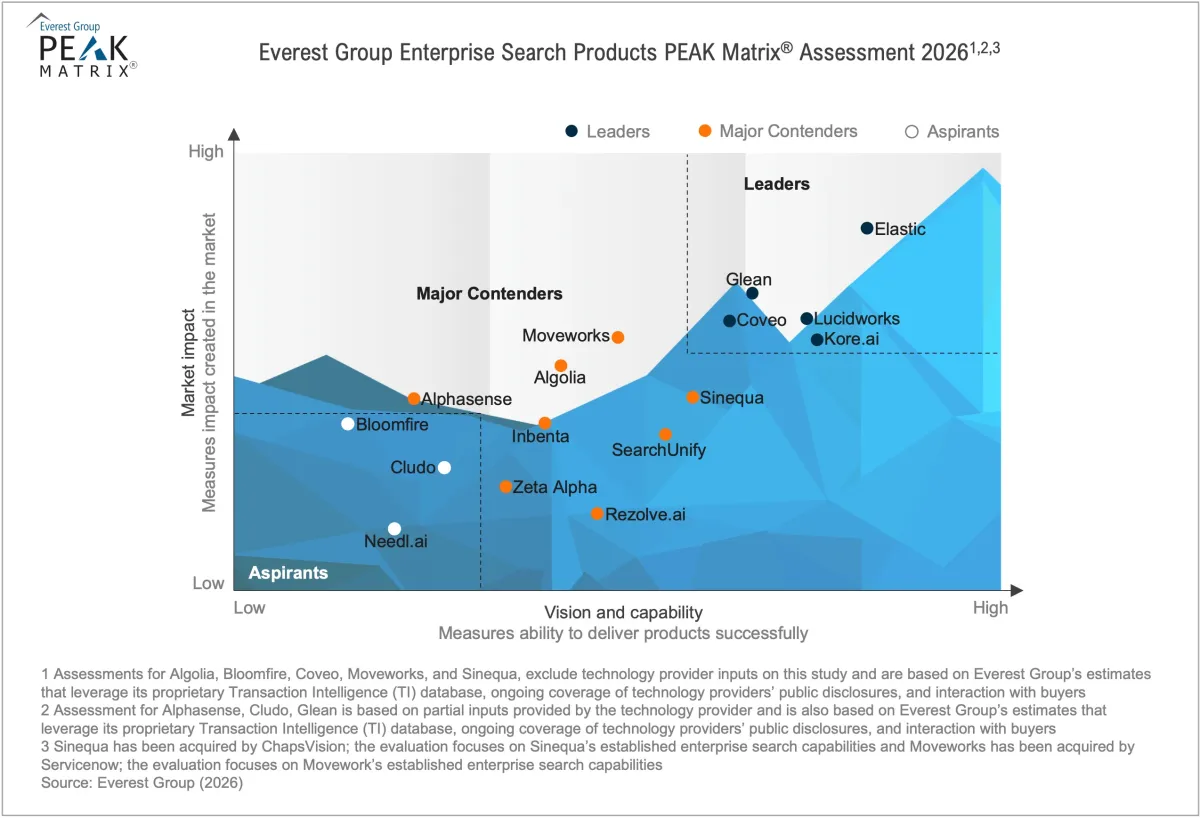
The implications for e-commerce, digital experience teams, AI leaders, and enterprise technology organizations are enormous.
The Search Market Has Entered Its AI-Native Era
The core problem enterprises face today is not simply “finding information.”
It is managing the explosion of information distributed across:
- Product catalogs
- ERP systems
- PIM platforms
- Knowledge bases
- Collaboration tools
- CMS environments
- Support systems
- Cloud applications
- Internal documents
- Structured and unstructured data sources
At the same time, user expectations have changed dramatically.
Consumers and business buyers no longer expect search engines to merely retrieve links. They expect systems to understand intent, context, personalization signals, natural language, behavioral history, and even business objectives.
This shift is accelerating in both B2C and B2B commerce.
Modern buyers increasingly begin their journeys in a conversational way. They ask questions instead of typing keywords. They expect guided discovery instead of filtered navigation. They want AI-generated answers grounded in trustworthy enterprise content. And they increasingly expect digital experiences that resemble interacting with an intelligent assistant rather than browsing a traditional website.
Everest Group’s analysis captures this transition clearly:
“Traditional keyword-based search approaches are proving inadequate for delivering accurate, contextual, and secure information access.”
This is exactly why the market is pivoting toward hybrid search architectures that combine:
- Keyword retrieval
- Vector search
- Semantic understanding
- Behavioral relevance
- Machine learning
- Generative AI
- Knowledge graphs
- RAG pipelines
- Conversational orchestration
These are no longer experimental capabilities. They are rapidly becoming foundational enterprise requirements.
Why Hybrid Search Is Emerging as the Winning Architecture
One of the clearest trends in the market is the rise of hybrid search.
Pure vector search is not enough.
Pure keyword search is not enough.
Enterprises increasingly need systems capable of blending lexical precision with semantic understanding and behavioral intelligence.
This matters tremendously in e-commerce and product discovery environments where relevance is highly contextual and commercially sensitive.
For example:
- A B2B buyer searching for industrial equipment may use incomplete terminology
- A consumer may ask a conversational question instead of using product keywords
- A support agent may need grounded answers sourced across multiple repositories
- An employee may require secure access to role-specific knowledge
- A merchandising team may need business rules layered on top of AI relevance
Hybrid search architectures solve these challenges by combining multiple retrieval methods into a unified relevance framework.
This is one reason Lucidworks has invested heavily in hybrid search and AI-native retrieval strategies across both SaaS and self-hosted deployment models.
The market increasingly recognizes that enterprises need flexibility. Some organizations prioritize rapid cloud-native innovation through SaaS. Others require governance, compliance, customization, or infrastructure control that self-hosted environments enable.
The future is not one deployment model replacing another.
The future is optionality.
RAG Is Reshaping Enterprise AI
Retrieval-Augmented Generation (RAG) has quickly emerged as one of the defining architectural patterns of enterprise AI.
Why?
Because enterprises cannot rely on generic large language models alone.
Without retrieval grounding, generative systems hallucinate, fabricate information, and introduce unacceptable business risks.
Everest Group specifically highlights the growing importance of:
- Permissions-aware retrieval
- Governance
- Operational oversight
- Trusted AI
- Secure enterprise knowledge access
- Hallucination reduction
This is precisely where enterprise search becomes strategic infrastructure.
RAG systems depend on high-quality retrieval pipelines. If retrieval quality is poor, generative AI quality collapses.
In other words:
AI is only as good as the search infrastructure beneath it.
This is entirely changing how enterprises evaluate search vendors.
Search platforms are no longer being evaluated solely on query response speed or indexing scale. They are increasingly evaluated on their ability to power:
- Enterprise AI assistants
- Conversational commerce
- Agentic workflows
- AI-generated recommendations
- Personalized discovery
- Knowledge retrieval
- Trusted answer generation
- Multi-modal search experiences
The competitive landscape is rapidly shifting toward providers capable of delivering AI-native retrieval systems with governance and operational maturity.
Conversational Commerce Is Rewriting the Buyer Journey
The e-commerce experience itself is changing.
Historically, digital commerce interfaces revolved around:
- Navigation menus
- Search boxes
- Category pages
- Filters
- Product grids
Those paradigms are evolving into conversational discovery systems.
Buyers increasingly expect experiences like:
- “Find me replacement parts compatible with this equipment.”
- “Compare these products based on sustainability requirements.”
- “Recommend alternatives under budget.”
- “What is the best configuration for my industry use case?”
- “Summarize differences between these products.”
This requires far more than traditional search.
It requires:
- Intent understanding
- Context memory
- Product relationship modeling
- AI-generated summaries
- Behavioral personalization
- Governance-aware retrieval
- Real-time relevance optimization
This evolution is especially important in B2B commerce, where purchases are often technically complex, high-value, and multi-stakeholder.
The organizations winning in this environment will not simply have the largest product catalogs.
They will have the most intelligent discovery experiences.
Enterprise Search Is Converging With AI Operations

Another major market shift is the convergence of enterprise search with broader AI infrastructure strategies.
Search platforms are increasingly expected to function as:
- AI retrieval layers
- Knowledge orchestration engines
- Context providers for agents
- Security-aware AI gateways
- Enterprise relevance engines
Everest Group’s emphasis on agentic workflows and conversational systems directly reflects this convergence.
This is a critical strategic inflection point for enterprises.
Many organizations initially approached generative AI as a standalone application problem.
The market is now realizing it is fundamentally a data access, retrieval, relevance, and governance problem.
That realization favors platforms designed for enterprise-scale retrieval and relevance engineering.
Why Speed and Adaptability Matter More Than Ever
The pace of change in digital commerce and enterprise AI is accelerating dramatically.
Buyer behavior is evolving quickly.
AI models are evolving quickly.
User interfaces are evolving quickly.
Search expectations are evolving quickly.
The companies that succeed will not be those waiting for the market to stabilize.
They will be the organizations building adaptable, AI-native platforms capable of evolving continuously alongside changing buyer behaviors and emerging AI architectures.
This is why Lucidworks continues leaning aggressively into:
- AI-native search
- Hybrid retrieval
- RAG infrastructure
- SaaS innovation
- Self-hosted flexibility
- Relevance optimization
- Conversational AI
- Governance-aware AI systems
- Enterprise-grade scalability
These are not isolated product decisions.
They are responses to structural changes reshaping the enterprise search and product discovery market itself.
Summary: Key Enterprise Search Market Shifts
| Market shift | What enterprises need | Why it matters | How Lucidworks aligns |
|---|---|---|---|
| Keyword search is becoming insufficient | Semantic and hybrid search | Buyers use natural language and conversational discovery | Hybrid search and AI-native retrieval |
| Explosion of enterprise data | Unified knowledge discovery | Data is fragmented across systems | Federated search and enterprise connectors |
| Rise of generative AI | RAG and grounded AI responses | Reduces hallucinations and improves trust | AI-powered retrieval and governance-aware access |
| Conversational buyer journeys | Natural language product discovery | E-commerce UX is shifting toward AI assistants | Conversational AI and intelligent discovery |
| Governance becoming critical | Permissions-aware AI | Enterprises need secure, compliant AI systems | Governance-aware enterprise retrieval |
| Multi-model deployment requirements | SaaS and self-hosted flexibility | Enterprises have varied infrastructure needs | Full SaaS and self-hosted platform options |
| AI is becoming operational infrastructure | Enterprise-scale relevance systems | AI depends on retrieval quality | Search as the intelligence layer |
| Rapid market evolution | Adaptable AI-native platforms | Static architectures become obsolete quickly | Continuous innovation and flexible architecture |
The Future of Search Will Belong to AI-Native Platforms
The enterprise search market is no longer evolving incrementally.
It is being fundamentally redefined.
Search is becoming:
- The foundation for enterprise AI
- The engine behind intelligent commerce
- The retrieval layer for generative systems
- The orchestrator of enterprise knowledge
- The interface for modern digital experiences
The organizations that recognize this shift early will be positioned to deliver faster, more intelligent, and more trusted digital experiences across both B2B and B2C environments.
The Everest Group Enterprise Search Products PEAK Matrix® Assessment 2026 reflects this transformation clearly and reinforces the accelerating importance of AI-native, governance-aware, hybrid search architectures in the future enterprise landscape.
At Lucidworks, we believe enterprise search is no longer just about helping users find information.
It is becoming the intelligence infrastructure powering the next generation of enterprise AI and digital commerce.
Frequently Asked Questions (FAQ) About Enterprise Search, AI, and Product Discovery
What is enterprise search?
Enterprise search is a technology platform that enables organizations to index, retrieve, and deliver information across structured and unstructured data sources, including websites, product catalogs, knowledge bases, cloud applications, collaboration tools, and internal systems. Modern enterprise search platforms increasingly use AI, semantic understanding, and hybrid retrieval techniques to improve relevance and personalization.
What is hybrid search?
Hybrid search combines traditional keyword-based retrieval with semantic vector search and machine learning relevance techniques. This approach allows organizations to deliver more accurate and contextual search results by balancing lexical precision with an AI-driven understanding of intent and meaning.
Why is keyword search no longer enough?
Keyword search struggles with natural language queries, conversational discovery, incomplete terminology, and contextual understanding. Modern users expect search systems to understand intent, preferences, relationships, and context rather than simply matching exact words. AI-native search platforms address these limitations through semantic retrieval, personalization, and generative AI.
What is Retrieval-Augmented Generation (RAG)?
Retrieval-Augmented Generation (RAG) is an AI architecture that combines enterprise search retrieval systems with large language models (LLMs). Instead of relying solely on a model’s training data, RAG retrieves relevant enterprise content in real time to generate more accurate, grounded, and trustworthy responses.
Why is RAG important for enterprise AI?
RAG helps reduce hallucinations and improves the accuracy of AI-generated answers by grounding responses in approved enterprise content and real-time data sources. This is especially important for organizations handling sensitive information, regulated data, or mission-critical business operations.
How is AI changing e-commerce product discovery?
AI is transforming e-commerce from static navigation and keyword search to conversational, personalized discovery experiences. Buyers increasingly expect intelligent recommendations, natural language interactions, AI-generated product summaries, guided selling experiences, and context-aware search results across both B2B and B2C commerce.
What is conversational commerce?
Conversational commerce refers to digital shopping and product discovery experiences powered by AI assistants, conversational interfaces, and natural language interactions. Instead of browsing categories manually, users can ask questions, compare products, request recommendations, and receive AI-generated guidance.
What are agentic workflows in enterprise search?
Agentic workflows are AI-driven processes where intelligent systems autonomously retrieve information, perform tasks, reason through workflows, and orchestrate actions across enterprise systems. Modern enterprise search platforms increasingly serve as the retrieval and context layer powering these AI agents.
Why does governance matter in enterprise AI search?
Governance ensures AI systems respect permissions, security policies, compliance requirements, and operational controls. As enterprises scale generative AI initiatives, governance-aware retrieval helps reduce hallucination risks, prevent unauthorized access, and maintain trusted AI experiences.
What is semantic search?
Semantic search uses AI and vector embeddings to understand the meaning and intent behind queries, rather than relying solely on keyword matching. This allows systems to return more relevant and contextually accurate results, even when users use conversational or ambiguous language.
What is the difference between SaaS and self-hosted enterprise search?
SaaS enterprise search platforms are cloud-managed and optimized for rapid innovation, scalability, and operational simplicity. Self-hosted enterprise search provides organizations with greater infrastructure control, customization, governance flexibility, and deployment options for regulated or complex environments.
Why are enterprises investing more heavily in enterprise search platforms?
Enterprise search has evolved into a foundational AI infrastructure layer supporting knowledge discovery, employee productivity, digital commerce, AI assistants, customer experience, and generative AI initiatives. As data volumes and AI adoption grow, organizations increasingly require intelligent retrieval systems that deliver secure, contextual, and trustworthy access to information.
What did Everest Group identify as key enterprise search market trends?
According to the Everest Group Enterprise Search Products PEAK Matrix® Assessment 2026, the market is rapidly evolving toward:
- Hybrid and semantic search
- Generative AI integration
- Retrieval-Augmented Generation (RAG)
- Conversational AI
- Agentic workflows
- Permissions-aware retrieval
- Governance-aware AI systems
- Multi-modal and context-aware search experiences
Why was Lucidworks recognized as a Leader by Everest Group?
Lucidworks was recognized for its vision and capabilities in AI-powered enterprise search and discovery, including hybrid search, semantic retrieval, conversational AI, governance-aware access, and Retrieval-Augmented Generation (RAG). Everest Group evaluated providers based on market impact, vision, and enterprise search capabilities. Read our new release.