
Everyone Has AI. Few Are Doing It Well: Introducing the 2026 B2B Commerce AI Benchmark
Executive Summary
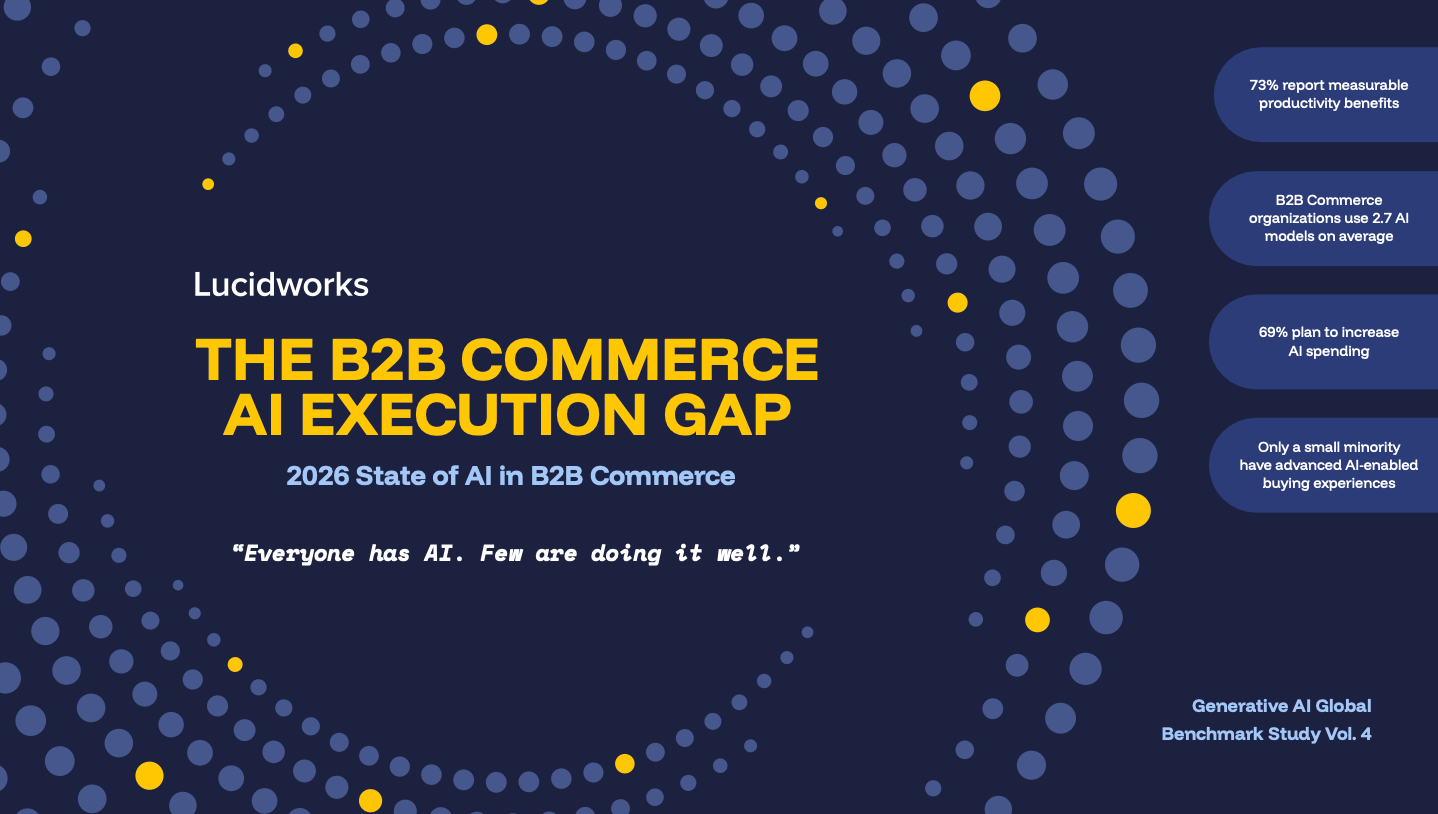
Lucidworks’ fourth annual Generative AI Global Benchmark Study takes a focused look at B2B commerce—and finds a market at a turning point. AI adoption is now nearly universal: 69% of B2B commerce organizations plan to increase AI spending, 73% report meaningful productivity gains, and companies deploy an average of 2.7 AI models.
But adoption is no longer the story. The story is the widening gap between organizations that have AI and organizations that have operationalized it. Advanced buying experiences—guided selling, technical interrogation, autonomous workflows—remain rare, even as nearly half of companies believe they’re ahead of their peers.
This report, a companion to our general Generative AI Benchmark, combines global survey data with independent evaluations of live B2B digital experiences to show exactly where the execution gap sits and how to close it.
The Conversation Changed in 2026
For three years, B2B commerce teams raced to launch pilots, test generative AI, and stand up chat interfaces. In 2026, the pressure shifted. Revenue leaders now expect measurable outcomes. Digital teams are accountable for productivity gains. And buyers—conditioned by consumer AI experiences—expect intelligent product discovery as table stakes.
The new benchmark captures this shift with a two-part methodology. First, Lucidworks surveyed B2B commerce professionals across e-commerce, digital experience, merchandising, product discovery, AI strategy, and technology leadership. Second, our Market Assessment Agent independently evaluated real-world B2B digital experiences across search, personalization, conversational commerce, AI enrichment, and governance. In other words, we measured what companies say against what they actually deploy.
The verdict? AI maturity cannot be measured by announcements alone.
<<< Download the B2B Commerce AI Benchmark Report >>>
What Is the B2B Commerce AI Execution Gap?
The AI execution gap is the distance between adopting AI tools and operationalizing them into measurable, revenue-driving buying experiences. Most B2B commerce organizations now deploy multiple AI tools, use commercial foundation models, and run conversational interfaces. Far fewer have achieved advanced orchestration, autonomous buying experiences, or mature governance.
That gap is now the defining competitive divide in B2B commerce. The next advantage won’t come from access to models—AI itself is rapidly commoditizing. It will come from the quality of operational execution.
Key Findings from the 2026 Benchmark
| Finding | What the Data Shows |
|---|---|
| AI investment keeps climbing | 69% of B2B commerce organizations plan to increase AI spending in 2026 |
| Productivity leads the value story | 73% report meaningful productivity gains; employee and customer satisfaction both hit 68% |
| Progress is beating expectations | 44% say AI progress has exceeded their original plans |
| Overconfidence is widespread | 47% believe they outperform peers on AI maturity—only 8% think they’re behind |
| Multi-model is the new normal | Companies use 2.7 AI models on average; 47% mix commercial and open models |
| Google leads model adoption | Gemini-family models appear in roughly three-quarters of deployments; OpenAI remains heavily deployed, and Anthropic continues growing |
| Workforce anxiety is rising | 45% express major concern about job disruption—the fastest-growing concern in the study |
| Advanced experiences remain rare | Guided selling, autonomous workflows, and cross-system orchestration are still uncommon |
The ‘Above Average’ Paradox
One of the most striking findings: 47% of B2B commerce organizations believe they outperform peers on AI maturity, another 43% believe they’re on par, and only 8% think they’re behind. Statistically, that math doesn’t work. Nearly everyone believes they’re winning—but the independent assessment data suggest otherwise. Many organizations still struggle with advanced orchestration, conversational commerce, governance, and operational AI workflows.
The market, in short, is overestimating its own AI maturity. That’s exactly why we paired survey data with an independent evaluation this year.
The Great AI Plateau
Progress is real—but differentiation is rare. Most organizations have implemented search optimization, product discovery improvements, personalization, and AI productivity tools. Far fewer have shipped guided selling, autonomous workflows, advanced conversational commerce, or cross-system orchestration.
The result is a growing plateau: everyone is improving, but few are separating from the pack. The benchmark’s capability curve makes this concrete. Core search features are widely deployed. AI-enriched experiences are progressing. But truly AI-enabled experiences—agentic self-service, interactive configuration, MCP/ACP-enabled buying—remain extremely rare. The next competitive divide will emerge above the plateau.
Chatbots Are Not Buying Assistants
Most organizations now offer chat interfaces, basic Q&A, and AI assistants. Far fewer provide guided selling, technical interrogation, context-aware recommendations, or transactional workflows. Conversational interfaces are becoming expected; operational conversational commerce remains rare. There is a major difference between a chatbot and a buying assistant—and buyers can tell.
Governance Is Becoming Competitive Infrastructure
Security maturity in B2B commerce is strong. Governance maturity is not. The benchmark found strong security controls alongside limited advanced guardrails and significant governance variation. That matters because trust increasingly influences buyer confidence, adoption, accuracy, and brand credibility. The next AI battleground is trust.
What AI Leaders Do Differently
Organizations widening the execution gap in their favor share consistent patterns. They prioritize outcomes over novelty, invest in foundations like search and relevance, measure results rather than announcements, strengthen governance early, and optimize continuously. The strongest AI organizations think operationally, not experimentally—and execution maturity compounds faster than experimentation maturity.
Our recommendations for 2027: strengthen discovery and relevance, prioritize practical buying experiences, operationalize governance early, invest in orchestration, and measure outcomes rather than deployments.
Read the Full Report
The 2026 B2B Commerce AI Benchmark is a companion to our general Generative AI Global Benchmark Study, drilling into the sector where the execution gap is widest and the opportunity is largest. Download the full report to see the complete capability curve, sector comparisons, and year-over-year trends—and schedule a no-cost AI Execution Review to understand where your organization truly stands.
Frequently Asked Questions (FAQs)
What is the Lucidworks B2B Commerce AI Benchmark? It’s the B2B commerce-focused edition of Lucidworks’ fourth annual Generative AI Global Benchmark Study, combining global survey data from B2B commerce leaders with independent evaluations of live digital commerce experiences conducted by the Lucidworks Market Assessment Agent.
What is the AI execution gap in B2B commerce? The AI execution gap is the difference between adopting AI tools and operationalizing them into measurable buying experiences. Most organizations have deployed AI; far fewer have achieved advanced orchestration, guided selling, or autonomous workflows that drive revenue.
How many AI models do B2B commerce companies use? B2B commerce organizations use an average of 2.7 AI models. 47% use only commercial models, 47% combine commercial and open models, and Google Gemini-family models appear in roughly three-quarters of deployments.
Is AI investment in B2B commerce still growing? Yes. 69% of B2B commerce organizations plan to increase AI spending in 2026, and investment is following results: organizations realizing very high benefits are the most likely (75%) to increase spending.
What should B2B commerce leaders prioritize in 2027? The benchmark recommends five priorities: strengthen discovery and relevance, prioritize practical buying experiences, operationalize governance early, invest in orchestration, and measure outcomes rather than deployments.How can I assess my organization’s AI execution maturity? Lucidworks offers a no-cost AI Execution Review using the Market Assessment Agent, which identifies capability gaps, governance readiness, conversational maturity, product discovery opportunities, and competitive positioning.