
Enterprise Search Is the AI Infrastructure Layer

Executive Summary
For years, enterprise search was viewed as a utility. Employees used it to find documents. Customers used it to locate products. IT teams maintained it as another enterprise application.
That view is rapidly becoming outdated.
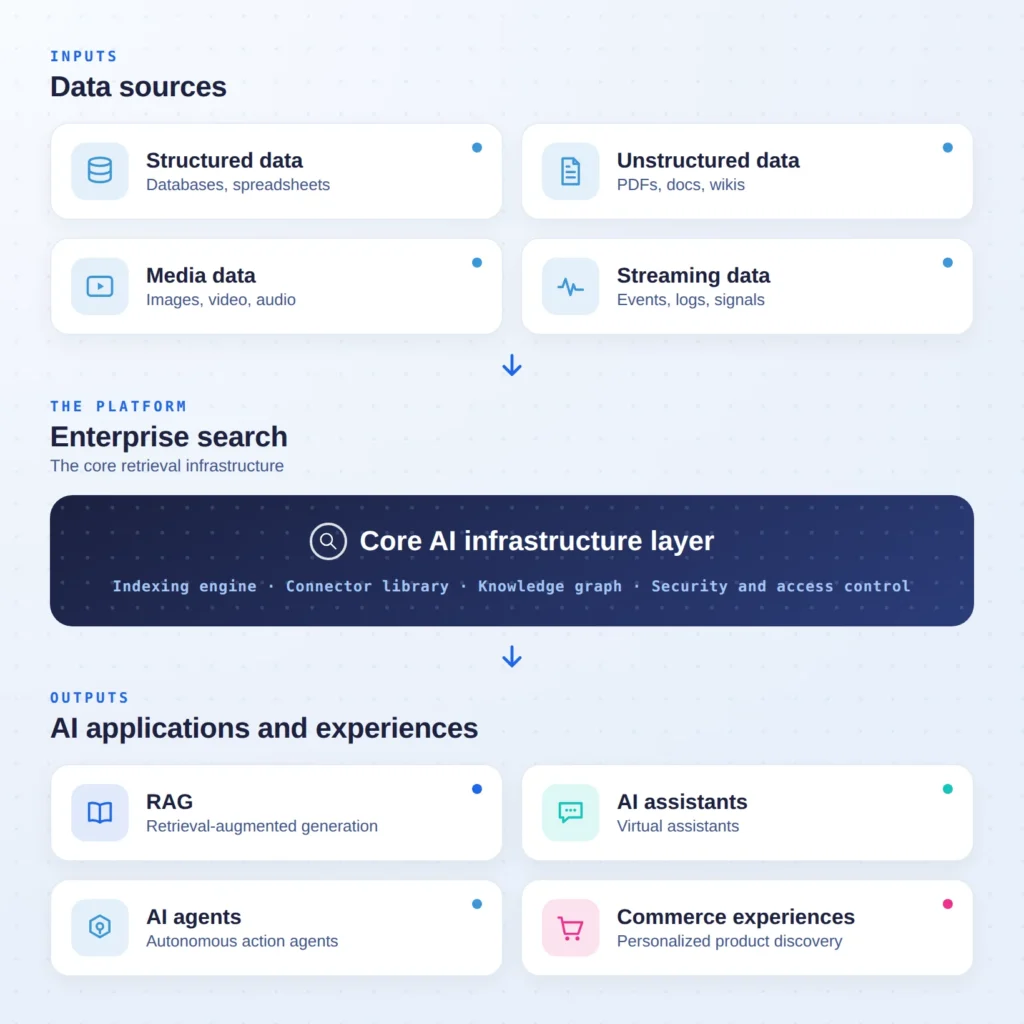
As organizations invest in generative AI, Retrieval-Augmented Generation (RAG), AI assistants, and AI agents, enterprise search is evolving into something much more strategic: the retrieval infrastructure that powers enterprise AI.
The success of modern AI systems depends on their ability to find relevant, secure, and trustworthy information. Enterprise search increasingly provides that foundation.
In this article, we’ll explore:
- Why enterprise search is becoming AI infrastructure
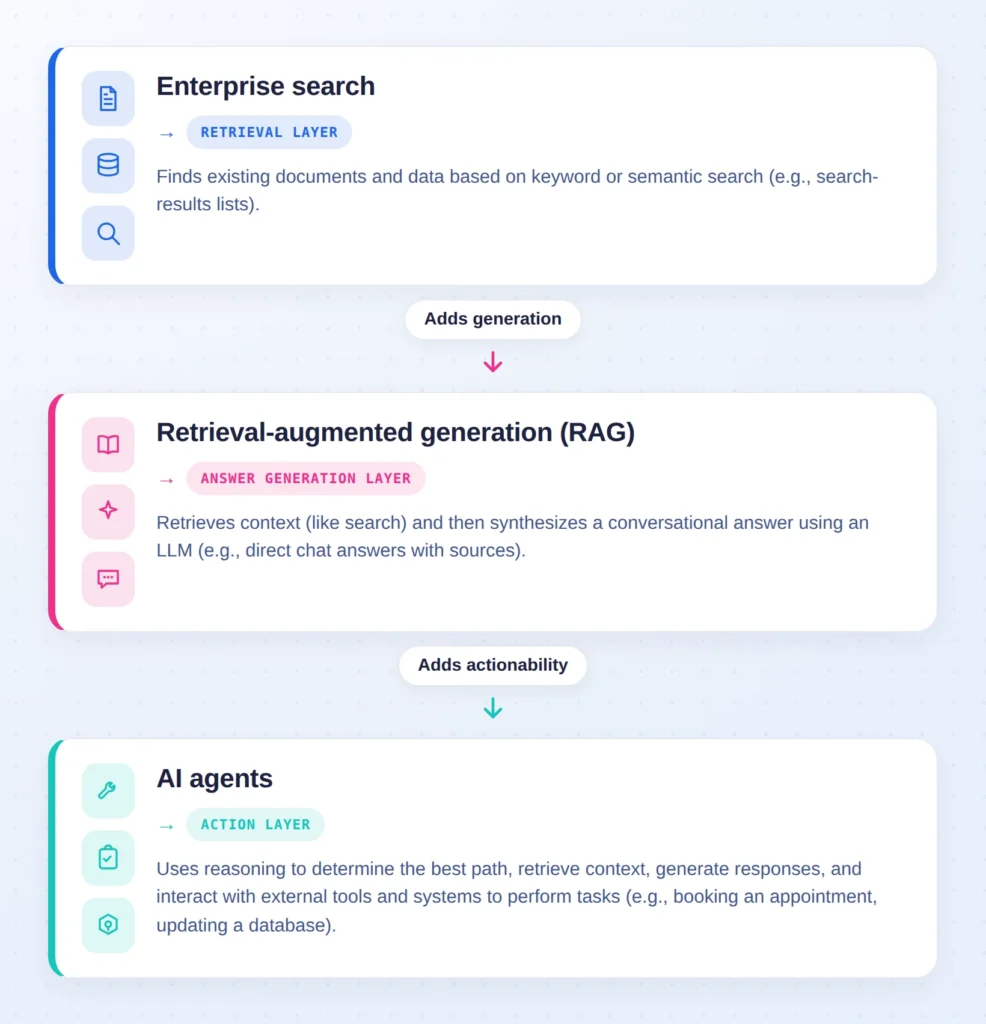
- The relationship between enterprise search and RAG
- How AI agents depend on retrieval
- Why hybrid search matters more than ever
- What enterprise leaders should look for in modern search platforms
- The future of enterprise AI and enterprise search
Quick Answers
| Question | Short Answer |
|---|---|
| Is enterprise search still relevant in the age of AI? | Yes. Enterprise search is becoming more important because AI depends on retrieval. |
| Does RAG replace enterprise search? | No. RAG relies on enterprise search capabilities to retrieve relevant information. |
| Can AI agents work without enterprise search? | Only in limited scenarios. Most enterprise AI agents require a retrieval infrastructure. |
| Why is enterprise search becoming AI infrastructure? | It provides connectors, indexing, permissions, relevance, and retrieval for AI systems. |
| What is enterprise AI search? | Enterprise AI search combines traditional search, semantic retrieval, machine learning, and generative AI. |
The Biggest Misunderstanding in Enterprise AI
Many organizations believe AI is replacing search.
In reality, AI is increasing the importance of search.
When executives see an AI assistant generate an answer, they often focus on the large language model (LLM) that produced it.
What they don’t see is everything happening before the answer appears.
The AI system must:
- Find relevant information
- Retrieve trusted content
- Filter information based on permissions
- Rank sources by relevance
- Provide context to the model
These are all functions traditionally associated with enterprise search.
Without retrieval, even the most advanced AI model becomes disconnected from enterprise knowledge.
The result is often hallucinations, outdated information, or responses that fail to reflect company-specific knowledge.
This is why enterprise search is increasingly becoming the foundation of enterprise AI.
Enterprise Search Is Solving a Growing Problem
The average enterprise stores information across dozens—or even hundreds—of systems.
Common repositories include:
- SharePoint
- Microsoft Teams
- Salesforce
- ServiceNow
- Confluence
- Google Drive
- Product Information Management systems
- ERP systems
- Knowledge bases
- Internal websites
- Product catalogs
Information is scattered everywhere. AI cannot create value from information it cannot access. Before an AI assistant can answer a question, it must first find the information required to answer it.
Enterprise search provides the connective tissue that makes this possible.
Why Enterprise Search Matters More Than Ever
Historically, search was primarily about helping people find information. Today’s search platforms must help both people and machines.
Modern search platforms now support:
Human Search
- Employees who are searching for documentation.
- Customers searching for products.
- Support teams searching for policies.
AI Search
- AI assistants that are retrieving content.
- RAG applications grounding responses.
- AI agents gather context before taking action.
- As AI adoption grows, demand for retrieval grows alongside it.
- In many organizations, AI systems may eventually perform more searches than human users.
Enterprise Search and RAG: Understanding the Relationship
One of the most common questions technology leaders ask is:
“Do we still need enterprise search if we’re implementing RAG?”
The answer is simple:
Yes.
RAG depends on enterprise search.
Retrieval-Augmented Generation improves generative AI by retrieving relevant information before generating an answer.
That retrieval process requires:
- Connectors
- Indexes
- Relevance tuning
- Metadata enrichment
- Security enforcement
- Search analytics
These capabilities are core enterprise search functions.
Without a retrieval infrastructure, RAG systems struggle to provide accurate and trustworthy answers.
The future isn’t enterprise search versus RAG.
The future is enterprise search powering RAG.
AI Agents Need Search Even More Than Humans Do
AI agents are becoming one of the most talked-about technologies in enterprise software.
But agents have a fundamental challenge.
They cannot act intelligently without context.
Imagine an AI procurement agent tasked with helping a buyer locate a replacement industrial component.
Before it can make recommendations, the agent must:
- Search product catalogs
- Find compatible products
- Review specifications
- Check availability
- Access pricing information
Each step requires retrieval.
The same is true for:
- Customer service agents
- HR assistants
- IT support agents
- Manufacturing assistants
- Knowledge management assistants
The better the retrieval layer, the better the agent performs.
This is why enterprise search is becoming increasingly important in agentic architectures.
Why Hybrid Search Has Become the Enterprise Standard
Many organizations initially viewed semantic search as the future of enterprise search.
Semantic retrieval is powerful.
It helps users find information based on meaning rather than exact keywords.
However, enterprise environments contain content that still requires exact matching.
Examples include:
- Part numbers
- Product SKUs
- Regulatory codes
- Customer identifiers
- Technical terminology
A manufacturing engineer searching for “AB-1234 stainless fitting” expects an exact match.
A semantic approximation isn’t enough.
This is why leading organizations increasingly adopt hybrid search.
Hybrid search combines:
Lexical Search
Exact keyword retrieval.
Semantic Search
Meaning-based retrieval.
Together, they provide superior relevance.
Hybrid search is rapidly becoming the preferred architecture for enterprise search platforms.
Enterprise Search Is Becoming Enterprise AI Infrastructure
When organizations evaluate enterprise search platforms today, they are no longer evaluating a search engine.
They are evaluating the retrieval infrastructure.
Modern enterprise search platforms increasingly provide:
Connectors
Access to enterprise data.
Indexing
Unified content organization.
Metadata Enrichment
Additional context and understanding.
Permissions
Security and governance enforcement.
Retrieval
Lexical, semantic, and hybrid search.
Analytics
Optimization and measurement.
AI Integration
Support for RAG, assistants, and agents.
These capabilities collectively form the foundation of enterprise AI.
The Rise of Enterprise AI Search
Enterprise AI search represents the convergence of traditional search and artificial intelligence.
Modern enterprise AI search platforms combine:
- Search technology
- Machine learning
- Semantic retrieval
- Generative AI
- Personalization
- Analytics
The result is a shift from information retrieval to information understanding.
Instead of returning a list of documents, AI-powered search increasingly delivers:
- Answers
- Summaries
- Recommendations
- Actions
This creates better user experiences while maintaining trust and transparency.
What Enterprise Leaders Should Evaluate
As enterprise search becomes AI infrastructure, buying criteria are changing.
Organizations should evaluate platforms based on:
Retrieval Quality
Can users consistently find what they need?
AI Readiness
Can the platform support RAG and AI agents?
Security
Can it enforce permissions and governance?
Connectors
Can it access critical enterprise systems?
Analytics
Can teams continuously improve relevance?
Flexibility
Can it support future AI initiatives?
The organizations achieving the best AI outcomes are often those with the strongest retrieval foundations.
The Future of Enterprise Search
The future of enterprise search extends far beyond search boxes.
Search is becoming the intelligence layer connecting:
- Enterprise knowledge
- Business systems
- AI assistants
- AI agents
- Customer experiences
- Decision-making workflows
In the coming years, organizations will increasingly rely on enterprise search to:
- Power agentic workflows
- Enable enterprise AI
- Improve digital commerce
- Enhance knowledge management
- Accelerate customer service
The winners in enterprise AI won’t simply have better models.
They will have better retrieval.
And better retrieval starts with enterprise search.
Key Takeaways
- Enterprise search is becoming a strategic AI infrastructure layer.
- RAG depends on enterprise search capabilities.
- AI agents require retrieval to operate effectively.
- Hybrid search has emerged as the preferred enterprise architecture.
- Enterprise AI success increasingly depends on retrieval quality.
- Search platforms are evolving from information retrieval systems into enterprise intelligence platforms.
Organizations planning AI initiatives should view enterprise search not as a feature, but as foundational infrastructure.
Frequently Asked Questions (FAQ): Enterprise Search and AI
Is enterprise search still important with generative AI?
Yes. Generative AI relies on enterprise search capabilities to retrieve information and provide grounded responses.
What is enterprise AI search?
Enterprise AI search combines search technology, semantic retrieval, machine learning, and generative AI to improve information discovery.
Does RAG replace enterprise search?
No. RAG depends on enterprise search for content retrieval, indexing, relevance, and permissions.
What is the difference between semantic search and hybrid search?
Semantic search focuses on meaning and intent. Hybrid search combines semantic and keyword-based retrieval for better relevance.
Why do AI agents need enterprise search?
AI agents require access to enterprise information before they can make decisions or take actions.
What industries benefit most from enterprise search?
Manufacturing, B2B commerce, government, financial services, healthcare, technology, and knowledge-intensive organizations all benefit from enterprise search.
What should organizations look for in an enterprise search platform?
Key considerations include retrieval quality, AI readiness, connectors, security, analytics, deployment flexibility, and support for future AI initiatives.
Ready to Build the Retrieval Foundation for Enterprise AI?
Whether you’re deploying AI assistants, implementing RAG, enabling agentic workflows, or modernizing enterprise search, success starts with retrieval.
See how Lucidworks helps organizations unify enterprise knowledge, improve relevance, and create the retrieval infrastructure that powers modern AI experiences.